

Fulfillment is no longer a back-office function—it’s a competitive advantage. As customer expectations rise for faster delivery, fewer errors, and real-time visibility, brands are investing in fulfillment technology and automation to keep operations scalable and predictable. From warehouse digitization to robotics in fulfillment, the industry is shifting toward smarter systems that reduce manual work and improve accuracy across the entire order journey.
In this article, we’ll explore the future of logistics through the lens of automated fulfillment systems, AI, cloud platforms, and real-time tracking. We’ll also cover the practical challenges of technology adoption and what “future-ready” looks like for modern e-commerce operations. For a broader overview of fulfillment models and how they work end-to-end, you can also visit our fulfillment page.
Table of Contents
Understanding the Role of Technology in Modern Fulfillment
Technology has transformed fulfillment from a labor-heavy operation into a system-driven workflow. Today, fulfillment innovation is often less about “one big machine” and more about integrating the right tools—WMS, OMS, carrier integrations, barcode scanning, and analytics—so that every step runs with consistency. This wave of logistics technology is enabling warehouses to move faster, make fewer mistakes, and deliver better customer experiences without constantly expanding headcount.
At the same time, fulfillment is becoming more measurable. With warehouse digitization, leaders can track throughput, pick accuracy, cycle times, and exception rates in real time—turning operations into a controllable engine rather than a daily firefight. In practice, e-commerce automation is about reliability: building workflows that maintain quality even as order volume fluctuates.
How Technology Transforms Order Fulfillment
Modern fulfillment improves when workflows become digital and repeatable. Digital logistics systems route orders automatically, generate pick lists, and apply packing rules based on SKU type, destination, and shipping method. That means fewer manual decisions, less confusion, and fewer “human bottlenecks” when volume spikes.
This is where automated workflows shine. Automation can trigger label creation, scan validation, and customer notifications the moment an order is processed. Over time, technology-driven fulfillment creates a consistent baseline of performance—so every order is handled with the same discipline, not dependent on who is working the shift.
The Shift Toward Data-Driven Logistics
The biggest shift in fulfillment isn’t only hardware—it’s the move to data-driven fulfillment. Instead of guessing what went wrong, teams can see the root cause: which SKUs generate the most exceptions, which zones slow down picking, and which carriers underperform in certain regions. This is operational clarity powered by logistics analytics.
With stronger data foundations, businesses can move toward predictive decision-making—anticipating issues before they become costly. Forecasting order volume, planning labor, and adjusting inventory placement become proactive tasks. Ultimately, data turns fulfillment from reactive execution into strategic optimization.
AI, Robotics, and Cloud-based Solutions
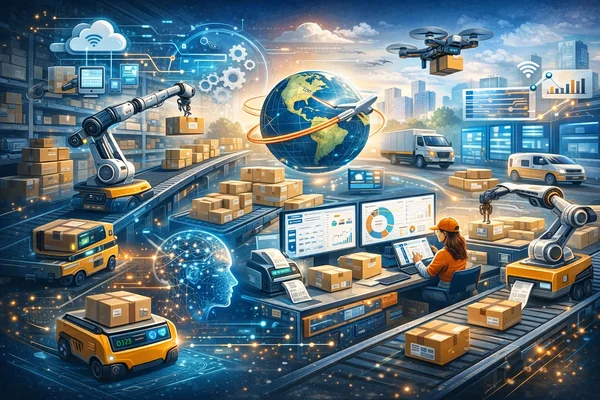
Three technologies are shaping the next decade of fulfillment: AI, robotics, and cloud platforms. Together, they create intelligent logistics systems that can respond faster, learn from performance trends, and scale without adding complexity. While not every business needs robots today, almost every business benefits from smarter software, better visibility, and more automation in decision-making.
The most practical path is often layered: start with strong integration and clean data, then apply AI where it delivers quick wins (forecasting, routing, exception prediction), and adopt robotics where volume and labor constraints justify it. This is how AI in supply chain management becomes real—tied to measurable operational improvements.
Artificial Intelligence for Smarter Fulfillment
AI helps warehouses make better decisions faster. AI fulfillment software can improve demand forecasting, recommend reorder points, and predict potential delays based on historical patterns. This reduces stockouts, overstocking, and operational surprises—especially during seasonal peaks.
More importantly, AI can drive automated order management. Orders can be routed to the best warehouse, assigned the most suitable shipping method, and flagged for risk (fraud, address issues, high-return SKUs). With predictive analytics, operations become more stable because exceptions are identified early.
Robotics in Warehousing and Order Processing
Warehouse robotics is accelerating in fulfillment centers that need high throughput. Robotics can support automated transport (moving totes), robotic picking systems, sorting, and even partial packing automation. This reduces walking time, increases speed, and keeps performance consistent during peak demand.
However, automation in logistics with robotics works best when processes are already standardized. Robots amplify good workflows and expose weak ones. The best results come when robotics complements humans—handling repetitive movement—while people focus on exception management and quality control.
Cloud-Based Fulfillment Platforms
Cloud tools are now the backbone of scalable fulfillment. Cloud fulfillment systems allow real-time syncing across channels, warehouses, and partners—especially in multi-location and 3PL environments. Instead of disconnected spreadsheets, teams operate from a single source of truth.
With SaaS logistics platforms, upgrades are faster, integrations are more flexible, and performance dashboards are easier to share. Most importantly, real-time data synchronization enables better customer communication—accurate stock, accurate ETAs, and clean tracking flows.
Real-time Inventory Tracking Benefits
Real-time visibility is one of the most valuable upgrades a fulfillment operation can make. Real-time inventory tracking reduces stock discrepancies, prevents overselling, and improves operational confidence. When inventory and orders are connected in an integrated fulfillment system, every department—from marketing to customer support—works with the same information.
Live visibility also increases accountability. If an order is delayed, you can see whether the issue is in picking, packing, carrier handoff, or inventory availability. This improves problem-solving speed and increases fulfillment accuracy—because errors are detected early and corrected faster.
Improving Order Accuracy with Live Tracking
Order accuracy improves when scans and validations are built into the process. With order tracking automation, each step confirms the right SKU, right quantity, and right destination. Real-time stock updates reduce the chance of picking from incorrect locations or shipping inventory that isn’t actually available.
In practical terms, real-time stock data reduces refunds, reships, and customer frustration. Accurate fulfillment protects margin and reputation. Even small accuracy improvements compound at scale—especially for businesses with large SKU catalogs.
Enhancing Customer Experience Through Transparency
Customers don’t only want fast delivery—they want clarity. Fulfillment transparency improves customer trust because buyers can see where their order is and what to expect. This reduces support tickets and increases satisfaction even when delivery is not instant.
Shipment visibility is also a competitive differentiator. Proactive status updates, clean tracking links, and honest ETAs create a “reliable brand” feeling. In modern e-commerce, that emotional confidence often matters as much as price.
Integration with E-commerce and ERP Platforms
To achieve real-time tracking, systems must connect. ERP integration ensures inventory data is consistent across purchasing, accounting, and warehousing. Meanwhile, e-commerce syncing ensures orders flow instantly into fulfillment operations without manual handling.
For brands selling on multiple channels, multi-channel fulfillment systems are essential. Without syncing, inventory becomes fragmented and accuracy drops. Integration is the foundation that makes automation trustworthy and scalable.
Automation Across the Fulfillment Workflow
Automation isn’t one tool—it’s a strategy applied across the workflow. A strong automated fulfillment workflow reduces repetitive work and standardizes decisions. From picking rules to carrier selection to exception alerts, automation creates operational consistency and protects performance under pressure.
The best approach is to automate the “predictable” work first. If 80% of orders follow standard rules, automation should handle that 80% reliably. Human teams then focus on the 20% that requires judgment. This is where logistics optimization becomes sustainable.
Automating Picking, Packing, and Labeling
Picking and packing are prime areas for automation. Barcode scans, pick-to-light systems, and guided workflows reduce error rates. Automated picking tools improve speed by reducing search time and optimizing routes inside the warehouse.
Packing automation can standardize box selection, inserts, and labeling rules based on SKU type. With barcode systems and strong validation, order preparation becomes faster and more accurate—especially in high-volume operations.
Smart Sorting and Routing Systems
Routing decisions can be automated using rules and real-time performance data. Automated routing can select the best carrier based on zone, cost, SLA, and reliability. Smart sorting can organize parcels by carrier, destination, or service level to reduce dispatch delays.
As sorting technology improves, warehouses can handle more volume with less congestion. Logistics AI systems can further optimize routing by learning which combinations deliver the best cost-to-performance outcomes.
End-to-End Automation from Order to Delivery
The long-term direction is end-to-end automation—connecting the entire pipeline. Fulfillment process automation begins when the order is placed and extends to shipping confirmation and delivery updates. This creates an order-to-delivery system that runs with minimal manual intervention.
When order routing, inventory allocation, packing rules, and tracking updates are linked, supply chain digitization becomes a real advantage. It reduces delays, improves customer communication, and creates operational predictability.
Benefits of Fulfillment Automation for E-commerce
Automation benefits show up in three places: cost, speed, and decision quality. By reducing manual tasks, automation lowers labor pressure and stabilizes performance—especially during demand spikes. The result is higher e-commerce fulfillment efficiency with fewer operational surprises.
But the biggest benefit is consistency. Automation creates a baseline of quality that doesn’t collapse under volume. That’s why cost reduction through technology is often as much about preventing errors as it is about reducing labor hours.
Reducing Human Error and Labor Costs
Human error is expensive: wrong items, wrong labels, damaged packaging, and missed cut-off times lead to refunds and reships. Automation improves accuracy by turning critical steps into validations. Error reduction protects both margin and brand trust.
Over time, labor optimization becomes possible because teams spend less time on repetitive tasks and more time on supervision, exception management, and process improvement. That’s a more sustainable model for growth.
Increasing Speed and Scalability
Automation increases throughput by removing bottlenecks. When systems generate picks instantly, label creation is automatic, and routing rules are predefined, processing becomes faster. Fast fulfillment isn’t just speed—it’s predictable speed.
With scalable workflows, the business can handle high-volume periods without constantly hiring and training temporary staff. Scalable automation provides elasticity—volume can rise without quality collapsing.
Data Insights and Performance Tracking
Automation creates cleaner data. When steps are logged, scanned, and validated, performance becomes measurable. This strengthens operational visibility and allows teams to improve systematically rather than guessing.
Tracking fulfillment KPIs—accuracy rate, cycle time, on-time dispatch, exception rate—helps leaders prioritize improvements. Over time, performance analytics turns fulfillment into a continuously improving engine.
Overcoming Challenges in Fulfillment Automation
Automation also comes with real challenges. Costs, integration complexity, and team adoption can slow progress. The best way forward is to treat automation as a staged roadmap: implement in layers, prove ROI, and expand after the foundation is stable.
The key is not buying technology “because it’s trendy.” Automation should solve specific problems: errors, delays, labor bottlenecks, inventory visibility gaps, or capacity limits. When automation is tied to clear outcomes, adoption becomes easier and success becomes measurable.
Managing Implementation Costs
Automation requires investment—hardware, software, integrations, and process redesign. The right lens is automation ROI: how much cost is reduced through fewer errors, higher throughput, and lower support volume. Often, the hidden savings are the biggest (fewer reships, fewer refunds, fewer tickets).
A smart approach is to start with high-impact software improvements—WMS upgrades, scanning discipline, carrier automation—before heavy robotics investments. This helps control fulfillment technology investment and makes budget planning more predictable.
Training Teams for New Systems
Even the best tools fail without adoption. Employee training must focus on workflow clarity: what changes, why it matters, and how success is measured. Training should be practical, not theoretical, and supported by clear SOPs.
Good adoption also requires buy-in. When teams see that new systems reduce chaos and reduce repetitive work, system adoption improves. A warehouse culture that values process discipline is the fastest route to sustainable automation.
Ensuring Seamless Integration
Integration is where many automation projects struggle. Tools must work together—shop platform, ERP, WMS, carrier systems, 3PL portals. Without integration, data becomes inconsistent and automation becomes unreliable.
Prioritize API integration and data governance early. Check system compatibility before committing to tools. When software syncing is stable, automation becomes trustworthy—and trust is what makes scaling possible.
The Future Outlook for Fulfillment Technology
The future is moving from automation to autonomy. As AI improves, systems will not only execute tasks but also recommend actions and predict outcomes. We’ll see more intelligent allocation, dynamic routing, and proactive exception handling. That’s the next stage of the future of fulfillment.
At the same time, sustainability will become a non-negotiable factor. Warehouses will be optimized not only for speed and cost but also for energy usage and emissions. The winning operations will combine efficiency with responsibility.
AI-Driven Predictive Fulfillment
Predictive fulfillment uses data to anticipate demand, allocate inventory, and prevent delays. Predictive logistics can reduce stockouts and improve delivery promises by aligning inventory with customer demand patterns.
With smart inventory forecasting, companies can plan replenishment and labor more accurately. AI-based automation will increasingly handle decisions like “where to ship from” and “which carrier to use” based on real-time constraints and historical performance.
Autonomous Vehicles and Drones in Logistics
Autonomous delivery is developing quickly in certain markets. Delivery drones and self-driving vehicles may eventually reduce last-mile costs and improve delivery speed in defined regions and use cases. However, widespread adoption depends on regulation, infrastructure, and safety requirements.
In the near term, autonomy will appear first inside warehouses—automated forklifts, mobile robots, and smart conveyors. Over time, autonomous logistics will expand outward from warehouses to transportation networks, creating more flexible fulfillment operations.
Sustainable and Green Automation Solutions
Green fulfillment technology is becoming more important as brands and regulators focus on emissions and waste. Eco-friendly automation includes energy-efficient equipment, smarter route planning, reduced packaging waste, and fewer reships caused by errors.
Sustainable logistics innovation often overlaps with cost savings. When systems reduce damage rates, optimize packaging, and prevent split shipments, both carbon impact and operational cost drop.