
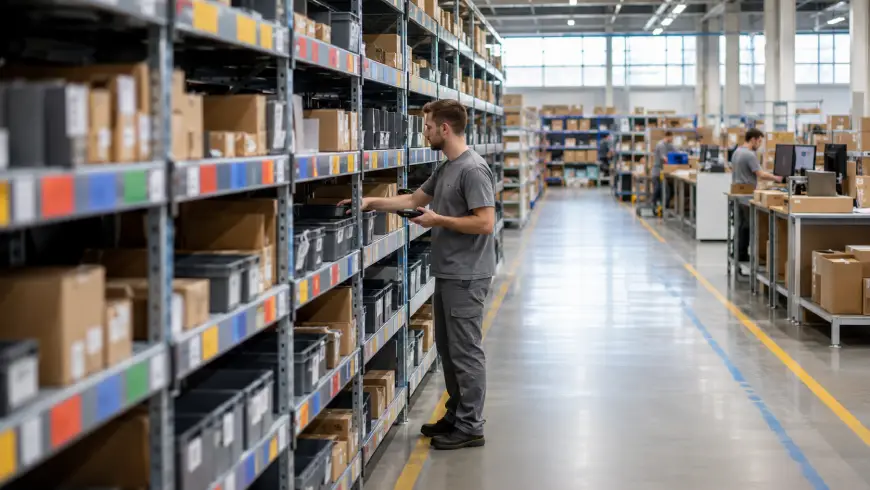

Slotting is one of the few warehouse decisions that a brand never sees, never approves, and never appears on an invoice as a line item — yet it quietly shapes how fast orders leave the building, how many of them go out wrong, and how much labor the operation consumes per shipment.
Most published guides on warehouse slotting are written for the person who owns the warehouse: here is the definition, here is ABC analysis, here is the slotting software you should buy. That framing is useful if you run your own facility. It is far less useful for the majority of e-commerce brands, who don’t own a warehouse at all — they work with a fulfillment partner and are affected by slotting decisions they never make.
This article takes the second perspective. It explains what slotting actually is, how it changes picking performance, how placement decisions get made, what goes wrong when they’re made badly — and, throughout, what a brand can reasonably ask of a fulfillment provider on this topic.
Table of Contents
Understanding the Basics of Slotting
Slotting is the process of deciding where each SKU physically lives inside a fulfillment center — which zone, which aisle, which rack level, and in which type of storage medium (pallet position, shelf, bin, carton flow lane).
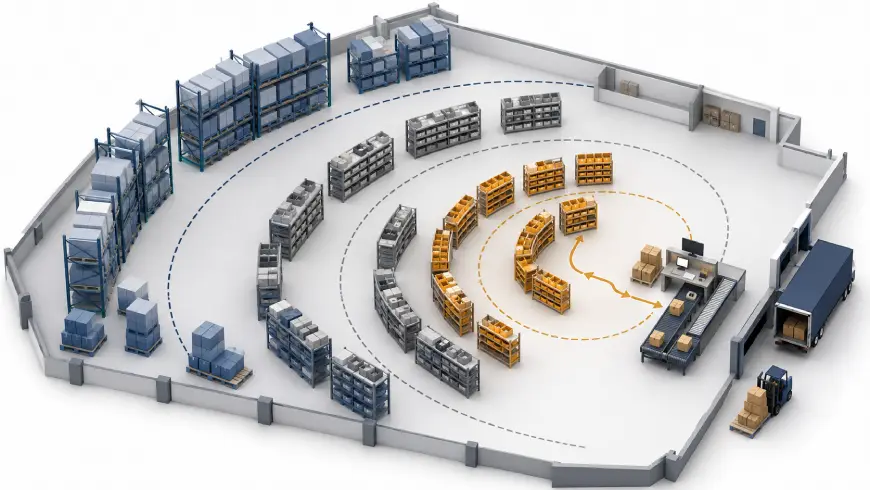
The core idea is simple: a warehouse is not a neutral container. Every location within it has a different cost. A bin at waist height, three meters from the packing bench, is expensive real estate — it is fast to reach, ergonomically easy, and gets touched dozens of times a day. A pallet position on the top level at the far end of the building is cheap real estate — it is slow to reach and requires equipment. Slotting is the discipline of matching each SKU to the location whose cost profile fits how that SKU actually behaves.
Two levels are usually distinguished. Macro slotting concerns the layout of the whole facility: where receiving sits relative to storage, where the pick zones are, and where packing and dispatch are positioned. Micro slotting concerns the individual SKU: which specific bin it occupies, how much space it gets, and what sits next to it. Brands almost never influence macro slotting — the building is what it is — but micro slotting for their own SKUs is very much a live, ongoing decision, and it is one worth understanding.
How Slotting Works in Daily Operations
In practice, slotting starts at inbound. When a shipment arrives and is received, someone or something has to decide where it goes. In a mature operation, this is not a human judgment call at the dock — it is a rule set inside the warehouse management system that assigns a putaway location based on the SKU’s profile: its dimensions and weight, its expected pick frequency, its storage requirements, and its relationship to other SKUs.
Once assigned, that location drives everything downstream. The picking route is generated from location data. The replenishment trigger — when stock at the forward pick face runs low and needs to be topped up from reserve storage — is tied to the slot. Cycle counting schedules are organized by zone. If the location assignment is wrong, none of these downstream processes can compensate for it; they simply execute the wrong plan efficiently.
This is why slotting behaves less like a project and more like a maintenance routine. A facility that slotted well eighteen months ago and hasn’t been revisited since is not well-slotted. It is a facility that was well-suited for an assortment and a demand pattern that no longer exists.
How It Differs from Random Storage
Random storage — sometimes called chaotic storage — assigns incoming stock to the first available location and relies entirely on the WMS to remember where everything is. It is not a failure state; it is a legitimate strategy with real advantages. Space utilization is very high because no capacity is reserved for a SKU that hasn’t arrived yet. Putaway is fast and requires little decision-making. For operations with enormous SKU counts and unpredictable receiving, it can outperform a rigid fixed-location model.
The trade-off is travel. Under pure random storage, a fast-moving SKU is just as likely to land at the far end of the building as next to the pack bench, and the picker pays for that on every single order. Fixed slotting reverses the trade: predictable, short travel for the SKUs that matter, at the cost of some reserved capacity and more decision-making at inbound.
Most well-run fulfillment centers use a hybrid. Reserve storage runs on random or semi-random logic to maximize density. The forward pick area — the zone where day-to-day picking actually happens — runs on deliberate slotting, with placement driven by velocity and product characteristics. Understanding this distinction matters when evaluating a provider: “We use WMS-directed putaway” describes the reserve area. The question that reveals operational maturity is how the forward pick face is governed.
How Slotting Improves Picking Speed
Picking is typically the largest labor cost in a fulfillment center, and most of the picking time is not spent picking. It is spent traveling between locations. Estimates vary by facility type and layout, but travel routinely accounts for more than half of a picker’s shift.
That ratio is what makes slotting economically significant. Improving how quickly someone grabs an item off a shelf yields very little. Reducing how far they have to walk to reach it changes the cost structure of the entire operation — and it does so without new equipment, software, or headcount.
Keeping Fast-Moving Products Closer
The most direct lever is velocity-based placement: SKUs that appear on the most order lines get the closest, most ergonomically accessible locations.
Two refinements matter here, and they’re where generic advice tends to stop short.
The first is that velocity should be measured in order lines, not units sold. A SKU that ships 4,000 units a month in cases of forty appears on 100 order lines. A SKU that ships 900 units a month as singles appears on 900. The second SKU is touched nine times as often and is closer to the pack bench, even though its unit volume is much lower. Ranking by units shipped is a common and expensive mistake.
The second is affinity: SKUs that frequently appear together in the same order should be slotted near each other, regardless of their individual velocities. A phone case and a screen protector that ship together on 60% of orders should not sit in different zones. Affinity-based placement is one of the highest-return refinements available and one of the least commonly applied, because it requires order-level rather than SKU-level analysis.
For brands whose assortment includes multi-item sets or pre-assembled bundles, affinity logic connects directly to how those bundles are built and stored — see our guide to managing kitting and bundling in fulfillment operations.
Reducing Walking Time for Staff
Beyond which SKU goes where, slotting shapes the geometry of the pick path itself. Well-slotted pick faces enable batch and cluster picking to work properly — one pass through a zone to collect items for multiple orders, rather than one pass per order. Poorly slotted ones force pickers to criss-cross the building, and batching no longer delivers benefits because the items in a batch are scattered.
Ergonomics forms the second half of this. The “golden zone” — roughly between knee and shoulder height — is where a picker can reach without bending or stretching. It is finite, and it should be allocated deliberately: high-velocity items and heavy items first. Slow-moving, lightweight goods can be stored at floor level or above shoulder height at minimal cost. Filling the golden zone by accident, or by whatever arrived first, wastes the most valuable space in the building.
The compounding effect is what makes this worth attention. A few seconds saved per pick line, across tens of thousands of lines a month, is not a rounding error — it is a measurable shift in cost per order and in how much volume the same team can absorb during a peak.
How to Decide Product Placement
Placement decisions rest on two inputs: how a SKU moves, and what a SKU physically is. Neither alone is sufficient.
Using ABC Analysis for Storage Decisions
ABC analysis segments the assortment by contribution to picking activity. A typical split assigns roughly the top 20% of SKUs by order-line frequency to category A — these often account for the majority of picks — with B and C covering progressively slower movers.
An item gets the prime forward locations. B items get the secondary zone. C items go to deeper storage, where travel costs are higher but incurred less often.
Three practical cautions apply.
Choose the analysis window carefully. Thirty days is standard, but for a seasonal assortment, a thirty-day window taken in a quiet month will misclassify products that are about to become A items. Rolling windows, compared against the same period in the previous year, produce more stable classifications.
Watch the C-tail. In most e-commerce assortments, category C is not a small residual — it often accounts for the majority of SKUs. How C items are stored (density, bin size, whether they’re consolidated) has a large effect on total space cost, even though they generate few picks.
ABC is a starting point, not the answer. It ranks by frequency alone and ignores size, weight, fragility, and affinity. Applied without those overlays, it will confidently place a bulky, awkward A item into a small golden-zone bin that cannot physically hold a week’s stock, creating constant replenishment interruptions.
The relationship between placement, replenishment triggers, and stock accuracy is covered in more depth in our article on the role of inventory management in fulfillment.
Considering Product Size and Fragility
Physical characteristics constrain and sometimes override velocity ranking.
Dimensions and weight determine which storage medium is even viable, and how much stock fits in the slot. A slot that holds two days of cover for a fast mover generates replenishment tasks constantly; the labor saved on picking gets spent on topping up. Correct sizing means the forward slot holds a sensible cover period at expected demand.
Weight also has an ergonomic dimension. Heavy items belong at waist height and, in multi-item picks, should be sequenced early so they sit at the bottom of the tote or carton — a slotting decision that prevents damage before packing ever begins.
Fragility typically requires dedicated storage: separated locations, protective media, and sometimes restricted stacking. Fragile items placed in high-traffic aisles accumulate handling damage that later surfaces as customer complaints and returns with no obvious cause.
Category-specific requirements cut across all of this — temperature control, humidity limits, segregation of scented from unscented goods, security zones for high-value items, batch and expiry tracking for cosmetics and FMCG. These are not slotting preferences; they are constraints that determine the feasible set of locations before velocity is considered at all.
This is also where product master data becomes decisive. If a SKU’s recorded dimensions and weight are wrong, every automated placement decision built on them is wrong. Master data accuracy is one of the few parts of slotting that sits squarely on the brand’s side of the relationship.
Problems Caused by Poor Slotting
Poor slotting rarely announces itself. There is no alarm, no failed process, no error message. Performance simply degrades — gradually enough that it gets attributed to volume growth, staffing, or carrier issues.
Lower Productivity and Longer Fulfillment Times
The first symptom is that lines picked per hour drift downward while everything else appears unchanged. Travel distance has increased because the assortment moved and the slots didn’t.
The second symptom is a rising volume of replenishment tasks. When fast movers sit in undersized slots, staff spend an increasing share of the shift topping up pick faces instead of picking. Worse, replenishment competes with picking for the same aisles, and congestion compounds the problem.
The third symptom is cut-off pressure. A well-slotted operation absorbs late order surges because the pick path is short and predictable. A poorly slotted one starts missing carrier cut-offs on high-volume days — and a missed cut-off is a lost delivery day for the customer, which is the point at which slotting stops being an internal warehouse concern and becomes a customer experience problem.
Because this shows up in labor cost per order, it also shows up in fulfillment pricing over time. Our breakdown of what drives the cost of fulfillment services covers how these operational factors translate into commercial terms.
Higher Error Rates in Order Preparation
Slotting drives a specific and common category of picking error: the confusable-neighbor mispick.
When visually similar SKUs — the same product in two sizes, two shades, two variants of near-identical packaging — are slotted adjacent to each other, pickers under time pressure will eventually grab the wrong one. Barcode scanning catches most of these, but not all, and the ones that escape produce a particularly costly failure: the customer receives something that looks nearly right, discovers the discrepancy after opening it, and initiates a return that carries both a shipping cost and a trust cost.
The countermeasure is deliberate separation of confusable variants, supported by clear location labeling and scan verification. Fashion brands feel this most acutely, since variant density is intrinsic to the category — a single style might exist in forty size-color combinations that differ only by a label.
A related failure mode is the stale slot: a SKU is moved, the location record isn’t updated, and pickers repeatedly find an empty or incorrect location. Each occurrence generates a search, an exception, and often a short pick that only surfaces at packing.
When Slotting Should Be Reviewed
Slotting decays because the conditions on which it was based change. Reviews should be scheduled, not triggered by visible problems — by the time problems are visible, months of degraded performance have already been absorbed.
Seasonal and Campaign-Based Adjustments
Demand does not distribute evenly across the year, and neither should slot assignments. Products that are category C in March may be category A in November. A layout optimized for baseline demand will underperform precisely when volume is highest.
Re-slotting before a peak should occur well before the campaign to be settled and stable — not during the ramp, when moving stock competes directly with fulfilling orders. Practically, this means treating slotting as a defined step in peak preparation rather than an afterthought. Our guide to preparing e-commerce operations for Black Friday and campaign periods sets this in the wider context of peak readiness.
Campaign-driven adjustments follow the same logic on a shorter timescale. A product about to feature in a major promotion, an influencer collaboration, or a marketplace campaign will see a demand spike that no historical analysis can predict — because it hasn’t happened yet. This is one of the clearest cases in which the brand holds information that the fulfillment partner does not. A promotional calendar shared two weeks in advance lets the operation pre-position stock. The same information does not arrive on launch day.
Continuous Improvement Based on SKU Movement
Between scheduled reviews, slotting should respond continuously to the assortment as it actually behaves. New product launches need a placement decision at introduction, not after three months of default storage. Discontinued lines should release their forward locations rather than occupying prime space as aging stock. SKUs whose velocity has shifted materially — in either direction — should be reclassified.
Dynamic slotting takes this further, with the WMS recommending or automatically executing re-slotting as movement data changes. It is powerful, but it has a prerequisite that is often understated: the cost of moving stock is real. Every relocation consumes labor and creates a window in which the location record and physical reality can diverge. A slotting model that recommends constant movement can consume more labor than it saves. The useful version applies a threshold — recommend a move only when the projected saving clearly exceeds the cost of making it.
Technology Used for Slotting Decisions
Slotting is fundamentally a data problem. The number of possible SKU-to-location assignments, even in a mid-sized facility, is far beyond what manual analysis can handle, and the underlying data changes weekly.
Using WMS Data for Better Placement
The warehouse management system is where the necessary data already lives: order line history by SKU, pick times by location, travel patterns, replenishment frequency, storage medium capacity, physical product attributes, and co-occurrence of SKUs on orders.
A capable WMS uses this to direct putaway automatically at inbound, apply and refresh ABC classification, flag slots that are undersized or oversized relative to actual demand, and surface affinity clusters that human analysis would miss.
The quality of these outputs depends entirely on the quality of the inputs — and the single most common failure point is product master data. Incorrect dimensions or weights produce wrong slot sizing, wrong packaging selection, wrong shipping cost estimation, and wrong placement, all from the same root cause. Brands sometimes treat master data as an administrative formality; in a data-directed warehouse, it is an operational input with direct cost consequences.
The relationship between WMS capability and broader operational discipline is explored further in our overview of warehouse management practices.
Turning Warehouse Data into Actionable Insights
Data becomes valuable only when it changes a decision. For slotting, a small number of metrics carry most of the signal: lines picked per hour by zone, average travel distance per order, replenishment tasks per pick line, mispick rate by location, forward-slot cover in days, and the share of golden-zone capacity occupied by A items.
Reviewed on a regular cycle, these reveal drift long before it becomes a service problem. Rising replenishment tasks per pick line indicate undersized slots. Mispicks clustering in specific locations indicates a confusable-neighbor issue. Falling lines per hour in one zone with others stable indicates a localized layout problem, not a staffing one.
For brands, this is the practical takeaway. You won’t need to manage slotting yourself. What you can reasonably do is ask your fulfillment partner a small set of questions that reveal whether slotting is actively managed or merely assumed:
- How often is slotting reviewed, and on what basis?
- Is velocity classification based on order lines or units?
- Is the affinity between frequently co-ordered SKUs taken into account?
- How is re-slotting handled ahead of peak periods, and what notice do you need from us?
- Which metrics would show us that slotting has degraded?
Providers running a disciplined operation answer these readily because the data is already in front of them. Vague answers are informative in their own way — and worth pursuing before the peak, not during it.
Slotting is invisible to the brand, but it is not neutral. It sits beneath cost per order, dispatch reliability, and error rate. Treating it as an internal warehouse detail leaves one of the highest-leverage parts of the operation entirely unexamined.
If you want to understand how slotting, storage strategy, and picking design are handled across our fulfillment centers in Turkey and Germany, explore our e-commerce fulfillment services or get in touch for an operational review.