


Turkey has quietly become one of the most important places in the world for making clothes that Europeans wear. In 2023, European brands’ volume of apparel sourcing from Turkey surpassed Vietnam for the first time in years, and Turkey now ranks as the third-largest textile supplier to Europe. The reasons are structural: EU-level quality without EU-level costs, a customs union that removes tariffs on industrial goods, and a proximity that lets Turkish factories quote lead times to Europe measured in days rather than the weeks a Far East supplier needs.
For decades, that manufacturing strength flowed to Europe in one form: wholesale. Turkish factories produced for European brands, who put their own labels on the garments and sold them to European consumers. The product was Turkish; the brand, the margin, and the customer relationship were not.
That’s changing. A growing number of Turkish manufacturers and designers are building their own brands and selling directly to European consumers — capturing the margin and the relationship that used to belong to their wholesale clients. But the jump from “we make excellent garments” to “we run a direct-to-consumer brand in Europe” rarely fails on the product. It fails on the fulfillment infrastructure that European D2C customers take for granted. This guide is about that infrastructure.
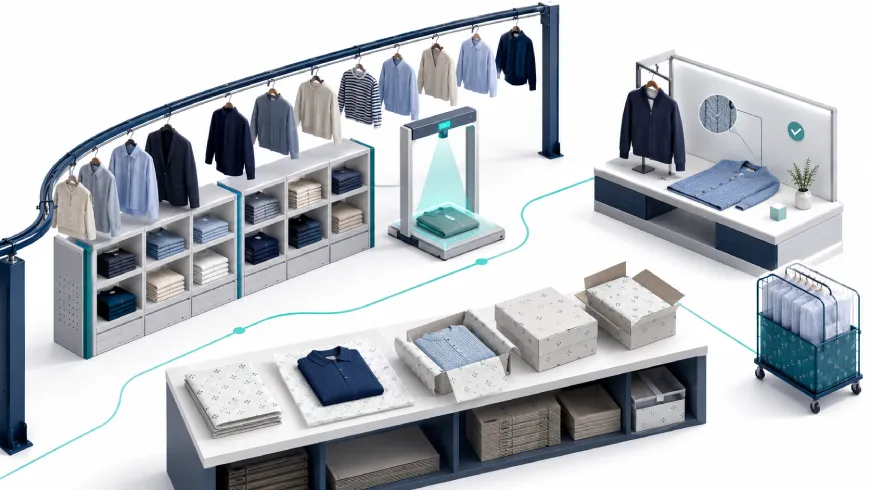
Why the Product Isn’t the Hard Part
A Turkish manufacturer moving to D2C starts with an advantage most new fashion brands would envy: the product is already good. The factory already meets or exceeds EU quality benchmarks — it has been doing so for European clients for years. The cost base is competitive. Often the OEKO-TEX or GOTS certifications European consumers look for are already in place, because wholesale clients required them.
What the factory doesn’t have — because wholesale never demanded it — is the consumer-facing operational layer. Wholesale ships pallets to a handful of business buyers on agreed dates. D2C ships hundreds or thousands of individual parcels to individual consumers, each expecting fast delivery, effortless returns, and an experience indistinguishable from an established European brand. That operational gap, not the product, is what determines whether the D2C move succeeds.
The gap has four main components: delivery speed, returns handling, the physical realities of shipping garments internationally, and the market-specific requirements European consumers and channels impose. Each is addressable — but each has to be deliberately built, because none of it carries over from the wholesale operation.
Delivery Speed: The Entry Ticket, Not the Differentiator
In the European fashion market — shaped by Zalando, About You, ASOS, and Amazon — a delivery time of two to three business days is the baseline expectation, not a premium promise. A Turkish brand shipping every order directly from Turkey lands at four to seven business days, and that gap isn’t a minor inconvenience. It’s a structural disadvantage that suppresses conversion before the product is ever seen, and it compounds: a customer who buys with lower confidence — from an unknown brand, with a long delivery estimate — is more likely to return.
The solution is the same one Turkish factories already use for their wholesale clients’ restocking: hold inventory in Europe. Bulk-shipping stock to a European fulfillment location (Germany is the common choice for its central geography and strong carrier network) and fulfilling orders locally turns a 5-to-7-day cross-border shipment into a 1-to-2-day domestic one. The customs-union advantage that makes Turkish wholesale attractive applies here too — most apparel moves into the EU without tariffs, provided the ATR.1 movement certificate documentation is correct.
The strategic sequence for most brands: start by shipping cross-border from Turkey to validate demand in a market, then position the best-selling styles in a European warehouse once the demand is proven. This staged approach — covered in depth in our guide to building fulfillment infrastructure from Turkey into Europe — avoids committing capital to European stock before the market justifies it.
Returns: Where Fashion D2C Actually Lives or Dies
Nothing separates wholesale from consumer fashion more sharply than returns. Wholesale returns are rare exceptions. Consumer fashion returns are a structural, high-volume reality — in the European market, apparel return rates commonly reach 40 to 50%, among the highest of any product category anywhere.
This is the single most important number a Turkish factory moving to D2C has to internalize, because it reshapes the entire operation. Roughly every second garment shipped may come back — which means the returns process isn’t a post-sale afterthought, it’s a core operational function that has to be built with the same seriousness as outbound fulfillment.
A local European return address is not optional. A German or French customer who has to ship a return back to Turkey experiences a break from everything they’re used to: longer transit, higher or unclear cost, and potential customs complications on the return leg. Return rates are high enough that this friction directly damages the brand. A local return address in the fulfillment market solves it — the return travels domestically, arrives in one to two days, gets inspected, and either goes back into local sellable stock or is consolidated for return to Turkey.
Return processing speed determines recovered value. A returned garment is inventory with a clock running on it — especially in fashion, where a returned item from the current season loses value fast if it sits unprocessed. Sellable returns should be inspected and back in stock within 24 to 48 hours. The inspection itself matters in fashion specifically: was the garment worn, are the tags intact, is there perfume or deodorant residue? These checks require trained staff and defined criteria, because the alternative — accidentally restocking worn garments — damages the brand with the next customer.
Bracketing is a behavior to design around, not eliminate. European fashion customers frequently order multiple sizes intending to keep one and return the rest. This is established behavior, not abuse, and the operation has to plan capacity around it rather than try to suppress it. What can be reduced is the avoidable return — the one caused by a sizing guess gone wrong or a product page that misrepresented the item.
Reducing returns at the source is a content problem, not a logistics one. A large share of fashion returns come from size uncertainty. Precise, product-specific size charts, information on the model’s measurements relative to the size worn, and fit feedback (“runs small”) measurably reduce size-driven returns. Tracking return reasons by SKU reveals which products have a content problem versus a genuine fit problem — an item with a high “not as described” rate needs its product page fixed, not its logistics.
The Physical Realities of Shipping Garments
Fashion fulfillment has physical requirements that a factory shipping folded, palletized wholesale goods may not have encountered in consumer form.
Hanging goods (GOH) versus flat-pack. Structured garments — blazers, dresses, tailored shirts — often need to travel and be stored hanging to avoid creasing and shape loss. Moving hanging goods from Turkey to Europe requires garment-on-hanger transport, a more specialized and costly mode than standard palletized freight. A factory that has only ever shipped folded wholesale cartons needs to plan this explicitly — discovering the requirement when the first blazers arrive creased is an avoidable brand-damaging mistake.
Consumer packaging is a brand moment. Wholesale ships in plain cartons; the buyer never sees them. D2C packaging is the customer’s first physical contact with the brand. For streetwear and basics, a branded polybag is efficient and sufficient. For premium and mid-market fashion, tissue wrapping and a proper unboxing experience build trust — which matters more, not less, for a brand the customer hasn’t heard of before.
Variant complexity multiplies SKUs. A single style in four sizes and three colors is twelve SKUs; a forty-style collection is 480 active units. The operational challenge isn’t just the count — it’s that size S and M, or two close color shades, look nearly identical at a glance. Barcode-verified picking, where every pick is validated against the order, is the only reliable defense against mix-ups at this variant density.
Market-Specific Requirements European Channels Impose
Selling into Europe means meeting requirements that the home market didn’t impose — and that wholesale clients used to handle.
Textile labeling in the market’s language. EU textile labeling rules require fiber composition to be stated accurately, and consumer-facing safety and care information must be in the language of the market — German for Germany, French for France. Labeling that satisfied the Turkish domestic market or a wholesale client’s specification doesn’t automatically meet this; it may require re-labeling, which becomes a fulfillment-center process at inbound.
Certifications the brand already has but doesn’t show. Many Turkish factories already hold OEKO-TEX or GOTS certifications because wholesale clients required them. Moving to own-brand D2C, the critical step is surfacing these certifications to the end consumer — on the product page, in the parcel — rather than leaving them buried in a supplier file. A certification the customer can’t see delivers none of its trust value.
Marketplace standards. Selling through Zalando, About You, or Amazon’s European marketplaces means meeting each platform’s operational standards: defined dispatch times, structured product data with correct size charts, and a return rate within platform tolerance. These are naturally achievable with a local European fulfillment operation and structurally difficult with cross-border-from-Turkey shipping — another reason the European warehouse becomes essential as marketplace volume grows.
Peak Season on the European Calendar
A Turkish brand selling to Europe has to plan around the European retail calendar, which differs from the Turkish one. The European fashion peak runs through Black Friday, the pre-Christmas weeks, and the end-of-season sales — and critically, it doesn’t end at Christmas.
The European market’s high return rates create a second peak that catches many operations unprepared: the January returns wave. In the first weeks of January, the returns from the entire Christmas selling period arrive at once, and in fashion this wave can reach three to four times a normal week’s return volume. An operation that plans capacity only for the outbound Christmas peak — and lets staffing wind down at year-end — hits January with an exhausted team and a returns backlog. Planning capacity through mid-January, not just to Christmas, is the difference between a clean peak and a January of delayed refunds and stranded inventory.
Choosing a Fulfillment Partner for the Factory-to-D2C Move
For a Turkish manufacturer making this transition, the fulfillment partner is what bridges the gap between factory capability and consumer-facing operation. The relevant evaluation questions are specific to this move:
Does the partner have physical infrastructure in both Turkey and Europe, able to manage the bulk transfer, the customs documentation, and the local European fulfillment on one system? Can they handle garment-on-hanger transport for structured pieces? Do they operate a local European return address with fashion-grade inspection — worn/tags/odor checks against defined criteria — and 24-to-48-hour processing? Can their WMS handle the variant density of a full apparel collection with barcode-verified picking? And do they understand the market-specific requirements — textile labeling, certification display, marketplace standards — well enough to raise them before they become problems?
A partner running physical operations in both Turkey and Germany on a single system turns what would otherwise be two separate operations in two countries — with all the coordination cost that implies — into one distributed operation. That dual-market capability is the same infrastructure that underpins multi-warehouse fulfillment across the Turkey-Europe lane, applied specifically to the demands of fashion.
The Opportunity, Stated Plainly
Turkish fashion manufacturers hold a rare position: they already produce at the quality and cost that European brands have relied on for years — they’ve simply been doing it in the background, under someone else’s label. The move to their own brand, selling directly to European consumers, is a move to capture the margin and the customer relationship that used to flow to their wholesale clients.
The product gets them to the starting line — it’s already good enough. What determines whether they cross it is the fulfillment infrastructure: European stock positioning for competitive delivery, a local return operation built for fashion’s high return rates, the physical handling that garments require, and the market-specific compliance that European channels demand. Build that, and a Turkish factory becomes a European fashion brand. Skip it, and the product — however good — never gets the chance to prove itself.