

In e-commerce, fulfillment services encompass much more than simply “handing an order over to the carrier.” Warehousing, inventory management, order preparation, packaging, shipping integration, delivery tracking, and often returns management… When all these steps come together, they form the total cost of fulfillment services. Looking at this cost solely as a “fee per order” provides an incomplete picture, because there are many visible and hidden cost components behind the operation.
Conducting an accurate fulfillment cost analysis is critical for protecting a brand’s profitability. When logistics expenses are not kept under control, increasing sales volumes can inflate costs instead of increasing profits. In this article, I explain step by step the components that make up the fulfillment pricing structure, how costs differ between in-house and 3PL models, hidden cost items, and practical ways to reduce fulfillment expenses.
Outsourcing vs. In-House Operations
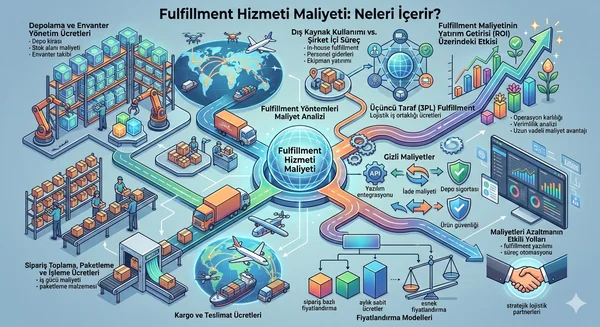
The cost structure differs between managing fulfillment in-house and outsourcing it to a third-party logistics provider (3PL). In an in-house model, fixed costs tend to dominate, whereas a 3PL model typically relies on service-based pricing and therefore has a more variable cost structure. Which option is more advantageous depends on factors such as order volume, growth rate, the complexity of storing the products, and the company’s capacity to manage an operational team.
The critical point here is not only the “cost today,” but also the scalability requirements over the next 6–12 months. As growth accelerates, choosing the wrong model can make costs increasingly difficult to control.
In-House Fulfillment Costs
In-house fulfillment costs usually start with clearly visible expenses but expand over time. Personnel expenses, warehouse managers, packing teams, shift structures, and training create fixed costs. In addition, equipment investments such as shelving systems, barcode scanners, printers, scales, and packing stations require significant upfront investment.
Operational fixed costs include rent, energy, security, insurance, maintenance, and repairs. During periods when order volume does not increase, these fixed expenses remain unchanged, which increases the cost per unit. In other words, an in-house model can be advantageous when capacity utilization is high, but it becomes more expensive when utilization is low.
Third-Party (3PL) Fulfillment Costs
3PL pricing is generally modular: storage + processing fees + additional services. With service-based pricing, costs increase as order volumes rise and may decrease when order volumes fall. This provides a more flexible structure, particularly for brands experiencing seasonal fluctuations.
However, there may also be unexpected costs with 3PL providers. Minimum monthly commitments, additional processing fees, custom packaging, return inspections, reporting, or integrations can increase the total cost. Therefore, it is important to understand the difference between the “quoted price” and the “invoiced price.”
Which Is More Suitable? Cost and Flexibility Comparison
When choosing a fulfillment method, looking only at the unit cost can be misleading. An in-house model offers greater control and customization but may create bottlenecks during periods of rapid scaling. A 3PL provider offers operational efficiency and scalability, but the level of control and contractual flexibility may be more limited.
The most appropriate approach when conducting a cost-benefit analysis is to think in terms of “total cost of ownership.” This means considering not only current expenses but also growth, error rates, return costs, and the impact on customer satisfaction.
What Is Fulfillment Pricing?
Fulfillment pricing covers the costs determined by a logistics provider for services offered to e-commerce businesses, such as warehousing, packaging, shipping, and returns management. Pricing is generally calculated based on per-order fees, storage costs, and additional service charges.
How Is Fulfillment Pricing Calculated?
Fulfillment pricing is determined based on the combined cost of different service components. Separate charges are typically applied for processes such as storage, order processing, packaging, shipping, and returns management. Businesses can choose between variable and fixed pricing models according to their needs in order to manage their budgets effectively.
Fulfillment pricing does not consist of a single cost item. The main components determining the final invoice are:
Storage: Space occupied (pallet/shelf/carton) and storage duration
Goods receiving: Counting, labeling, and put-away of incoming products
Picking and packing: Number of items per order, parcel size, and custom packaging
Shipping: Dimensional weight/weight, carrier agreements, and delivery region
Returns processing: Inspection, repackaging, and return to inventory
Value-added services: Bundling, serial/lot tracking, and expiration date tracking
Integration and reporting: Setup and ongoing services
When comparing fulfillment providers, you should look not at a single unit price but at the total cost generated by your specific order profile, including average number of items per order, product dimensions, return rate, and seasonal fluctuations.
Storage Fees
Storage fees are the charges sellers pay for keeping their products at a fulfillment center. These fees generally vary according to the following factors:
- Size of the storage area (calculated based on m³ or pallets)
- Length of time products remain in inventory
- Seasonal pricing (higher fees may apply during peak seasons)
Processing and Packaging Fees
Fulfillment centers charge fees for picking, packing, and preparing orders for shipment. These fees generally depend on:
- Processing cost per order
- Type of packaging used (standard boxes, custom packaging, additional protection for fragile products)
- Custom labeling and branded printing
Shipping and Distribution Fees
Fulfillment providers establish agreements with specific carriers to deliver orders to customers. Shipping costs may vary depending on:
- Delivery region (local, national, international)
- Shipment weight and volume
- Express or standard delivery options
- Special transportation requirements (for example, cold-chain logistics)
2.4. İade yöetimi ücretleri
İade süreçleri, müşteri memnuniyetini sağlamak için önemli bir faktördür. Fulfillment merkezleri iade edilen ürünleri işlemek için ek bir ücret talep edebilir. Bu ücretler genellikle şunları kapsar:
- Ürün kabul ve kontrol maliyetleri
- Yeniden stoklama ücretleri
- Hasarlı ürün imha maliyetleri
What Are Fixed Payments?
In addition to variable costs, some fulfillment services also require fixed payments. Businesses should take these fixed costs into consideration when managing their budgets.
Subscription or Platform Usage Fee
Some fulfillment providers charge a monthly or annual subscription fee for access to their services. This fee generally covers additional services such as customer support, inventory management software, and operational support.
Minimum Order Processing Fee
Some fulfillment providers may charge a minimum processing fee to businesses whose order volumes fall below a certain threshold. This fee is charged to cover the fulfillment center’s resources even during periods when the business has low order volumes.
Integration Fees
Some providers may charge an initial setup or integration fee to connect e-commerce websites with their fulfillment systems. This fee covers software integrations that enable orders to be automatically transferred to the fulfillment system.
Additional Service Fees
Some fulfillment centers may charge fixed fees for additional services outside their standard offering. These may include:
- Customized packaging
- Adding gift notes
- Product assembly
- Additional security and insurance services
What Should You Consider When Comparing Fulfillment Pricing?
When purchasing fulfillment services, e-commerce businesses should consider not only prices but also service quality and long-term costs. Some of the criteria that should be considered during the evaluation process include:
Transparent pricing policy: It is important to work with providers that offer clear pricing in order to avoid hidden fees.
Carrier agreements: Agreements between the fulfillment provider and shipping companies can directly affect both delivery times and costs.
Customer support services: A good fulfillment provider should have a strong support team for order management and potential operational issues.
Flexibility: Fulfillment companies that offer flexible solutions capable of adapting to changes in order volumes may provide greater advantages to businesses in the long term.
Fulfillment pricing plays a major role in optimizing logistics costs for businesses. In addition to variable costs such as storage, processing, shipping, and returns fees, fixed payments such as subscriptions, minimum processing fees, and integration costs should also be taken into consideration. Choosing the right fulfillment provider can improve your company’s operational efficiency while also increasing customer satisfaction.
Effective Ways to Reduce Costs
Reducing fulfillment costs should not mean reducing quality. On the contrary, as process efficiency improves, costs decrease while the customer experience improves. The objective is to reduce waste and lower the rate of operational exceptions.
Cost-effective fulfillment is generally achieved through technology, warehouse optimization, and the right partner strategy.
Using Technology and Automation
Solutions such as fulfillment software, barcode verification, automated label printing, intelligent order routing, and ERP integration reduce error rates and optimize labor costs. Process automation reduces operating expenses, particularly by accelerating repetitive tasks.
The greatest benefit comes from reducing the need for “manual corrections.” Manual corrections result in both lost time and additional errors.
Warehouse and Inventory Optimization
When inventory management is ineffective, storage costs increase and order preparation times become longer. For efficient use of warehouse space, shelving layout, product placement, accessibility of fast-moving products, and regular stock-counting processes are important. As inventory control improves, stock accuracy increases while the risks of delays and incorrect product shipments decrease.
Even small optimizations, such as selecting the right package size, can significantly reduce shipping costs.
Working with Strategic Logistics Partners
Cost sharing and operational collaboration with logistics partners can provide strong leverage, particularly for growing brands. The right partner may provide better rates through carrier agreements, improve delivery performance, and standardize processes.
The critical point is not to choose the “cheapest” partner, but rather the partner that optimizes total cost and service levels together.
The Impact of Fulfillment Costs on Return on Investment (ROI)
Viewing fulfillment costs solely as an expense gives an incomplete picture. Properly managed fulfillment improves operational profitability because speed, accuracy, and customer satisfaction can have a direct impact on revenue. Fewer returns, fewer customer complaints, and higher repeat purchase rates all indirectly affect ROI.
For this reason, investment in fulfillment is not only a cost consideration but also an important part of a company’s growth strategy.
How Is the Return on Fulfillment Spending Measured?
Performance metrics are required to measure return on investment. First, the “current state” is measured using KPIs such as order preparation time, error rate, delivery time, return rate, and the number of customer support requests. Changes are then monitored after improvements have been implemented.
When conducting a cost-benefit analysis, the question should not only be “How much money did I spend?” but also “How many errors were eliminated, how many orders were dispatched faster, and how many customer losses were prevented?”
Increasing Profitability Through Improved Efficiency
As operational efficiency increases, unit costs decrease. In addition, faster delivery improves the customer experience and increases customer loyalty. In the long term, this may also reduce advertising costs because repeat purchases increase.
n other words, fulfillment efficiency indirectly improves not only operational performance but also marketing performance.
Long-Term Cost Planning
Financial planning is essential for achieving long-term cost advantages. A logistics strategy should consider order volume projections, warehouse capacity, carrier agreements, technology investments, and returns processes together. Sustainable growth is not about simply “getting through this month”; it is about planning for the next 12 months.
For this reason, regularly recalculating fulfillment costs and revising processes based on data is one of the most reliable ways to protect profitability.