

Consumer expectations in 2026 won’t be shaped only by “faster delivery.” They’ll be shaped by stress, identity, wellbeing tech, and mobile-first shopping habits—forces that directly change what customers consider a good delivery experience. Euromonitor International’s Top Global Consumer Trends 2026 report frames these shifts as four behavioural trends and explains how brands can respond. Euromonitor-GCT-2026ConsumerTre…
In this article for fiCommerce, I’m interpreting the report through a practical lens: what these trends mean for ecommerce fulfillment, customer experience, and the operational choices (inventory, packaging, SLAs, returns, and cross-border). The takeaway is simple: in 2026, fulfillment will be one of the strongest “trust signals” a brand can control.
Table of Contents
How the report was built and why ecommerce teams should care
Euromonitor explains that the report is grounded in its Passport market research hub, paired with data analytics and expert insights, and is designed to help businesses plan innovation roadmaps with evidence. Euromonitor-GCT-2026ConsumerTre… It also positions the report as guidance for meeting evolving consumer demands and explicitly sets up four behavioural shifts for 2026. Euromonitor-GCT-2026ConsumerTre…
For ecommerce leaders, the key point is that these aren’t abstract “branding” ideas. Each trend changes what customers want in the buying journey (clarity, authenticity, clinical-grade performance, mobile-first convenience) and that pressure ultimately lands on operations—especially on the part customers physically experience: the package, the delivery promise, the tracking flow, and the returns process.
Trend 1: Comfort Zone — customers want calm, control, and reassurance
Euromonitor describes Comfort Zone as consumers carving out calmer, balanced, values-aligned lives in a volatile world—seeking tools that provide comfort, control, and reassurance. Euromonitor-GCT-2026ConsumerTre… The implication for brands is not merely “sell comfort,” but reduce friction and uncertainty across experiences.
In ecommerce, uncertainty often comes from basic operational issues: unclear delivery dates, confusing tracking, damaged parcels, missing items, slow refunds, or complicated returns. When consumers are already overwhelmed, those small pains become major reasons to switch brands—so fulfillment becomes a strategic growth lever, not just a cost center.
What the data signals
The report highlights how widespread stress is: 58% of consumers experience moderate to extreme stress daily, and 2 in 5 feel constant pressure to get things done. Euromonitor-GCT-2026ConsumerTre… This matters because stressed customers value reliability and simplicity more than novelty—they want fewer steps, fewer surprises, and fewer follow-ups.
Euromonitor also notes that two thirds of consumers look for ways to simplify their lives, and it ties pragmatism to climate adaptation: only 51% feel they can make a difference through their choices (down from 56% the year before), while air conditioner sales are forecast to surpass 189 million units globally in 2026. Euromonitor-GCT-2026ConsumerTre… The pattern is “less idealism, more practical control”—the same mindset customers bring to delivery expectations.
Fulfillment implications
For fulfillment, “comfort” translates into predictability. Clear ETAs, proactive delay notifications, and accurate picking/packing reduce the mental load customers feel after they pay. In 2026, the absence of problems will be interpreted as a premium experience.
It also means designing experiences that feel calm: fewer back-and-forth emails, fewer ambiguous tracking statuses, fewer “contact support” dead ends. When the delivery journey feels controlled, customers feel the brand is competent—especially in high-frequency categories where repeat purchases depend on confidence.
Action checklist for brands and 3PLs
Euromonitor’s Comfort Zone tactics emphasise designing products and experiences that simplify life, remove unnecessary complexity, and use AI/tech with a clear purpose. Euromonitor-GCT-2026ConsumerTre… Fulfillment teams can mirror this by simplifying shipping options, improving delivery-date accuracy, and using automation where it clearly reduces errors and delays.
A practical playbook: tighten warehouse QC, standardise packaging rules by product type, shorten picking paths, and treat returns/refunds as part of “reassurance.” The more dependable your order fulfillment is, the more your brand becomes a refuge in a chaotic environment.
Trend 2: Fiercely Unfiltered — radical honesty and hyper-relevance
Euromonitor defines Fiercely Unfiltered as an emerging energy built on bold self-expression and radical honesty, urging brands to move beyond one-size-fits-all and lean into authenticity while understanding diverse identities. Euromonitor-GCT-2026ConsumerTre… This is a trust-and-identity trend, and it punishes brands that overpromise or hide inconvenient truths.
For ecommerce, the “truth” customers care about is often operational truth: stock reality, delivery capability, return conditions, customs friction, and customer support responsiveness. When the message and reality diverge, customers don’t just leave—they talk.
What the report says
Euromonitor notes that 65% of consumers said their identity is accepted by society, framing authenticity and individuality as major drivers of behaviour. Euromonitor-GCT-2026ConsumerTre… In parallel, it states that more than 50% of consumers only buy from brands or companies they completely trust. Euromonitor-GCT-2026ConsumerTre…
That trust threshold is crucial: you don’t get multiple “second chances” when customers feel misled. A single bad delivery, unclear returns policy, or support loop can break confidence—especially when competitors are one click away.
Operational meaning for fulfillment
Fiercely Unfiltered forces operational transparency: realistic delivery promises (not marketing promises), honest stock availability, and straightforward returns. When customers perceive honesty, they tolerate friction better; when they perceive spin, they interpret normal issues as incompetence or deception.
This also affects packaging and presentation: customers increasingly judge brands by whether they deliver what they claim—literally and metaphorically. If you position yourself as premium, the unboxing, protection, and speed must match; if you position yourself as value, the experience must still be clean, accurate, and clear.
Practical moves: hyper-segmentation and co-creation
Euromonitor’s suggested tactics include translating authenticity into action through transparent engagement, using hyper-segmentation for specific buyer personas, developing hyper-personalised solutions, and even co-creating with loyal customers. Euromonitor-GCT-2026ConsumerTre… In fulfillment terms, this means tailoring delivery and returns to different customer needs instead of forcing a single policy on everyone.
Examples: flexible delivery windows for busy urban buyers, pickup/locker options for privacy-minded shoppers, premium packaging for gifting segments, and “instant exchange” flows for loyal repeat buyers. The operational winner in 2026 will be the brand that makes customers feel seen and keeps promises with consistent execution.
Trend 3: Rewired Wellness — clinical-level expectations become everyday
Euromonitor summarises Rewired Wellness as consumers wanting clinical-level, high-tech solutions as everyday wellness tools. Euromonitor-GCT-2026ConsumerTre… This is not only a product trend; it changes how customers evaluate quality, speed, and precision—expectations that spill into delivery, packaging, and returns.
Wellness categories (beauty, personal care, supplements, OTC, health tech) are increasingly “performance-led.” When customers buy performance, they want the entire journey to feel professional-grade—including the logistics behind it.
Science-meets-self-care: numbers to know
The report notes that 9% of consumers trying to lose weight take GLP-1s (up from 6% in 2024), and 3 in 4 consumers track their health with a device or app. Euromonitor-GCT-2026ConsumerTre… It also states that people now expect everyday products to match the precision, efficacy, and speed of pharmaceuticals or professional cosmetic services. Euromonitor-GCT-2026ConsumerTre…
Euromonitor quantifies the opportunity: projected global consumer expenditure on health goods and medical services is expected to reach USD 6.9 trillion in 2026, alongside strong signals in dermocosmetics and dermatologically tested products. Euromonitor-GCT-2026ConsumerTre…
What this does to delivery expectations
When customers want “clinical-grade” outcomes, they also want “clinical-grade” handling. That means they become more sensitive to damaged boxes, heat exposure risks, leakage, authenticity concerns, and slow delivery—because these issues can be interpreted as product degradation or safety risk.
It also raises the bar for service recovery: if a wellness order arrives wrong or late, the customer may not only be disappointed—they may feel it disrupted a routine or goal. In 2026, fast refunds, easy replacements, and reliable re-delivery become part of the perceived product value.
Fulfillment readiness for wellness categories
Euromonitor highlights that retail sales of dermocosmetics posted a double-digit CAGR in every region (2020–2024) and that 600+ new dermatologically tested products were launched online between September 2024 and August 2025. Euromonitor-GCT-2026ConsumerTre… Growth like that typically increases SKU complexity, bundle variety, and picking errors unless fulfillment processes mature.
Operationally, brands should invest in stronger QA, better packaging standards, batch/lot handling where needed, and clearer delivery communication. If your fulfillment can protect product integrity and reduce mistakes, you win trust in a category where trust equals repeat purchase.
Trend 4: Next Asian Wave — mobile-first commerce sets the standard
Euromonitor describes the Next Asian Wave as East Asian influence gaining ground, with Chinese players blending affordability and innovation with intuitive digital-first experiences—and pushing competitors to adopt tech-enabled models that deliver fast, authentic solutions. Euromonitor-GCT-2026ConsumerTre… This trend is tightly linked to how commerce is discovered (social), how it’s bought (mobile), and how it’s expected to arrive (quickly and smoothly).
For ecommerce operations, it means the “baseline expectation” is being reset by platforms and retailers that make buying feel effortless. Fulfillment has to keep pace with that pace of discovery and conversion.
TikTok Shop and mobile-first ecosystems
Euromonitor notes that as of early 2025, one in four TikTok users made a purchase on the platform. Euromonitor-GCT-2026ConsumerTre… These ecosystems win by compressing time: discovery → decision → checkout → delivery expectation.
That compression creates a new operational requirement: when marketing can generate demand instantly, fulfillment must absorb spikes without breaking SLAs. If your warehouse and carrier network can’t handle volatility, social commerce becomes a customer satisfaction trap.
Cross-border reality check: China’s scale
The report forecasts that in 2026 China will export USD 4 trillion in goods and services, and projects China’s cross-border retail ecommerce sales at USD 139.5 billion. Euromonitor-GCT-2026ConsumerTre… That scale matters even for non-Asian brands, because it increases competitive pressure on price, speed, and cross-border convenience.
As cross-border volume rises, customers also learn to expect better tracking, fewer customs surprises, and smoother returns—because leading marketplaces keep improving those experiences. Brands that ignore cross-border operations will feel the pressure in both customer acquisition cost and retention.
How to compete: speed + localisation + seamless journeys
Euromonitor’s recommendation is explicit: apply the same playbook—mobile-first, social-driven, tailored for digital natives, with compelling campaigns and seamless journeys becoming table stakes. Euromonitor-GCT-2026ConsumerTre… Fulfillment is a core part of that “seamless journey,” not an afterthought.
Operationally, localisation means more than translation: it includes delivery expectations, carrier preferences, returns logistics, and customer communication norms by market. Brands that build an adaptive fulfillment model will be better positioned to grow as the Asian wave shapes global standards.
What fiCommerce recommends: turning trends into a fulfillment roadmap
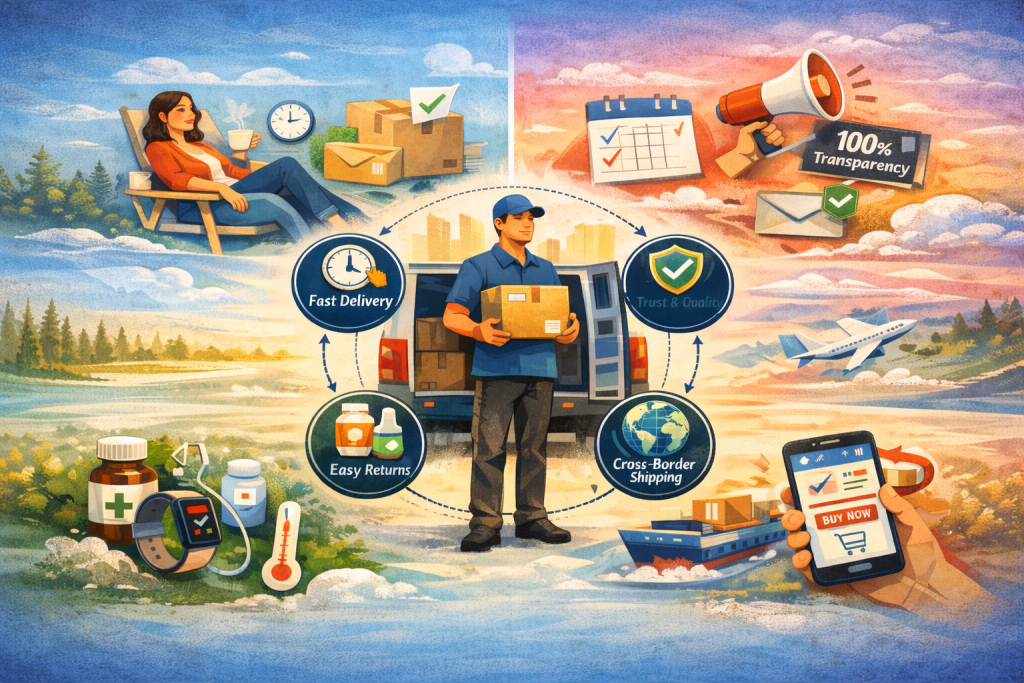
Across all four trends, the shared message is that confidence beats novelty. Customers want calm and control (Comfort Zone), truth and relevance (Fiercely Unfiltered), performance-grade consistency (Rewired Wellness), and frictionless mobile commerce (Next Asian Wave). The smartest response is operational: upgrade the parts of the journey customers can feel.
If you want a practical foundation for that, start by aligning your service levels, warehouse processes, packaging standards, and returns flows under a single fulfillment strategy—because consistency is what creates trust at scale. For a deeper overview, see fiCommerce’s fulfillment approach.
Conclusion: 2026 growth will be won in the last mile
Euromonitor’s research makes one thing clear: consumer change is not slowing down, and the winners will be the brands that reduce friction while increasing trust. The report’s four behavioural shifts are not abstract—they directly affect what customers expect when they click “Buy now.” Euromonitor-GCT-2026ConsumerTre…
If your ecommerce fulfillment is accurate, predictable, transparent, and designed for real customer needs, you won’t just meet expectations—you’ll turn delivery into a competitive advantage. For the original report and broader context, you can also follow Euromonitor International