

As of 2026, online shopping behavior is undergoing a significant transformation. Competition is no longer shaped solely by price; trust, transparency, and complete product information have moved to the center of purchasing decisions. Consumers are more informed, more comparative, and more selective than ever.
ChannelEngine’s Marketplace Shopping Behavior Report 2026, conducted with 4,500 online consumers, shows that marketplaces remain the most important starting point of the shopping journey. However, the critical difference is this: purchasing decisions are no longer made on a single platform but at the end of a multi-channel process where alternatives are carefully compared.
Marketplaces Remain the Starting Point
According to the research, 37% of consumers begin their online shopping journey on marketplaces. This shows that marketplaces are still strong “discovery hubs.” However, shopping behavior is no longer single-channel. Before making a purchase, consumers visit an average of three different marketplaces.
Even more striking is that 53% of consumers say they “always” or “frequently” compare the same product across different platforms. This clearly shows that price and content consistency are no longer optional — they are mandatory.
Price Is Important, But Not the Only Criterion
Price remains the strongest factor influencing purchase decisions on marketplaces. 48% of consumers cite low price as the most important criterion.
However, the decision-making mechanism is not limited to price alone:
- 36% fast delivery
- 32% product availability
- 26% product variety
are among the particularly decisive factors.
In addition, free shipping stands out as the strongest trigger in the decision process. 91% of consumers state that free shipping influences their purchasing decision. Furthermore, 95% say they notice price differences between different marketplaces.
This data sends a clear message to brands selling across multiple channels: price consistency and fulfillment performance form the foundation of trust.
Trust: The Real Determinant of Purchase
In 2026, competition has evolved into a “trust economy.” 60% of consumers say they hesitate to purchase products without reviews. 80% state that they make decisions based on star ratings and verified reviews.
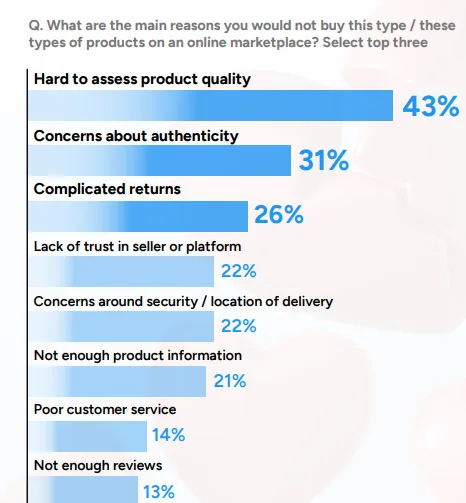
Among the reasons for not purchasing a product:
- 43% inability to assess product quality
- 31% suspicion about authenticity
- 26% complicated return processes stand out as key factors.
These findings show that incomplete product content or weak social proof can neutralize even a price advantage.
Mobile and Content Quality: The Hidden Power of Conversion
According to research, 51% of consumers primarily shop via mobile devices. 72% say that better size/measurement information would reduce the likelihood of returns. 67% state that they only purchase products they feel confident about.
This shows that product titles, descriptions, technical specifications, and visuals are no longer just SEO elements; they are factors that directly impact profitability. Incomplete or unclear content leads to a much faster loss of trust on mobile.
Social Commerce, Cross-Border Shopping, and the Impact of AI
The report further reveals that 62% of consumers are open to trying new or lesser-known marketplaces. 58% state that they shop from marketplaces outside their own country.
This demonstrates that cross-border e-commerce is no longer niche but mainstream behavior. However, 46% avoid international platforms due to trust concerns. Therefore, localization and trust elements are critical for global growth.
On the AI side, the picture is quite striking:
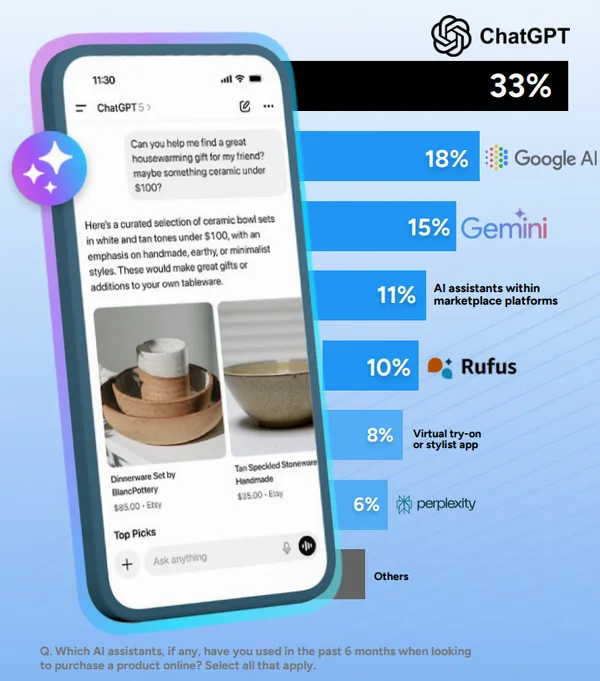
58% of consumers state that they use AI tools for product research. Among them, ChatGPT is the most preferred tool with a 33% usage rate.
Despite this, only 17% say they are ready to purchase directly via AI, while 32% say they would consider it for certain products. In other words, AI is powerful in the discovery phase, but trust remains decisive at the payment stage.
In a Multi-Channel World, Trust and Operational Consistency Win
The data from 2026 reveals a clear reality: consumers research everywhere but purchase only where they trust.
We are facing a consumer profile that compares an average of three marketplaces, notices price differences (95%), values free shipping (91%), and avoids products without reviews (60%).
At this point, it is critical for brands not only to be visible but to provide across all channels:
- Consistent pricing
- Complete and accurate product content
- Strong fulfillment performance
- Transparent return processes
- Trust signals (reviews, ratings, verified seller information)
Because competition is no longer a price war; it is a trust and experience war. And as of 2026, the winners will be the brands that can consistently deliver the same clarity, the same transparency, and the same sense of trust at every touchpoint where consumers compare.