

As of 2026, artificial intelligence (AI) platforms have become the fastest-growing digital category on the internet. According to the Meltwater Digital 2026 Global Overview report, more than 1 billion people worldwide actively use LLM and generative AI platforms.
This growth is reflected not only in user numbers but also signals a radical shift in web traffic, search behavior, and content consumption habits.
Leading AI Platforms of 2026
Traffic data presented in the Meltwater Digital 2026 report shows that AI websites are no longer niche tools but have become mainstream digital destinations.
Below, we examine some of the standout AI platforms of 2026 and their use cases in detail.
ChatGPT (OpenAI)
Category: Multi-purpose LLM platform
Use Cases: Content generation, analysis, coding, research, summarization
As of 2026, ChatGPT holds the position as the most visited AI platform in the world. The system generates billions of interactions daily and is widely used for:
- Blog writing and marketing copy generation
- Technical documentation creation
- Code writing and debugging
- Data analysis and reporting
- Strategic planning
The widespread adoption of enterprise versions has made the platform critical not only for individual users but also for companies.
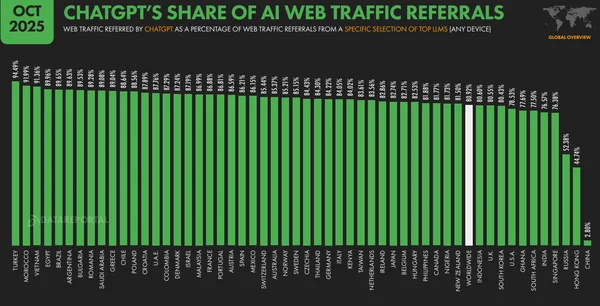
ChatGPT is currently the most visited AI platform globally. According to the report, Turkey ranks first in the world with a 94.4% share in AI web traffic referrals directed to ChatGPT. Morocco follows with 91.9%, and Colombia ranks third with 90.1%. This data reveals that ChatGPT holds a significantly stronger position in Turkey compared to other AI tools.
This demonstrates that ChatGPT is not merely a chatbot, but the dominant AI traffic generator on a global scale.
Google Gemini
Category: Integrated AI ecosystem
Use Cases: Search + generation + enterprise integration
Google’s Gemini platform combines the traditional search experience with generative AI. Its integration with the Gmail, Docs, Drive, and Google Cloud ecosystem provides a significant advantage.
According to Google Cloud’s AI Agent Trends 2026 report, AI agents are actively used in 52% of organizations. Gemini serves as one of the key infrastructures behind these agent systems.
Claude (Anthropic)
Category: Secure and long-context AI model
Use Cases: Long document analysis, enterprise content generation
Claude is particularly preferred for
- Long PDF analysis
- Legal document review
- Academic text synthesis
- Secure enterprise use
Thanks to its large data and long-context processing capacity, it is rapidly growing within the enterprise segment.
Microsoft Copilot
Category: Office-integrated AI
Use Cases: Word, Excel, PowerPoint, Teams integration
Microsoft Copilot integrates generative AI directly into business workflows:
- Excel data analysis
- PowerPoint presentation creation
- Word document drafting
- Meeting summaries
Through this integration model, it goes beyond being just an AI website and becomes a core component of productivity software.
Perplexity AI
Category: AI-powered search engine
Use Cases: Source-based research and information verification
Perplexity offers a hybrid model that combines traditional search engines with LLM architecture. It stands out especially for:
- Generating answers with cited sources
- Use in academic research
- Reference analysis in SEO and content strategy
The Rise of AI-Powered Search Models
Meltwater Digital 2026 data shows that AI platforms have not completely replaced traditional search engines; rather, they have differentiated their use cases
The usage distinction has become clear:
| Use Case | Platform |
|---|---|
| Quick information access | |
| Analysis and synthesis | ChatGPT / Claude |
| Enterprise productivity | Copilot / Gemini |
| Source-based research | Perplexity |
In summary, AI websites are not reducing web traffic but expanding it and creating a new usage layer.
AI Agent Architecture and the Evolution of Web Traffic
According to the Google Cloud report, AI agents no longer only generate responses; they can connect to tools and take action.
In this model:
- AI pulls data from the web
- Summarizes information
- Analyzes it
- Provides decision recommendations
- In some cases initiates actions
This transformation redefines the traditional model of “visit site → compare → decide.” The web is no longer just a destination; it has become a data source for AI systems.
According to the Google Cloud report, AI agents are no longer experimental; they are widely used in production environments. Agent usage has reached 49% in customer service, 46% in marketing and security operations, and 45% in technical support.
These figures show that AI has achieved tangible impact in operational processes.
Common Characteristics of AI Traffic
The most visited AI websites of 2026 share the following characteristics:
- Multi-Purpose Usage
They offer solutions to multiple needs rather than a single problem.
- Daily Usage Habit
They have become tools that are opened every day, similar to social media platforms.
- Enterprise Adoption
AI usage is evolving from an individual experience into a corporate necessity.
- Ecosystem Integration
They go beyond being websites and take on the role of APIs and infrastructure.
A New Era for SEO and Digital Strategy
The rise of AI platforms is transforming SEO approaches:
- AI models pull data from websites
- Structured data becomes more critical
- Authority and trust signals gain importance
- Being referenced by AI becomes a new visibility metric
Post-2026 digital success will depend on the combination of search engine visibility and AI visibility.
Conclusion
As of 2026, artificial intelligence platforms are not an alternative to the internet; they have become a smarter layer built on top of it. With over 1 billion active AI users, 52% enterprise agent adoption, and an 88% early-stage ROI success rate, this transformation is clearly not a temporary trend.
The most visited AI websites no longer simply provide information; they analyze, generate, and take action. This transformation also impacts e-commerce and fulfillment operations — from demand forecasting to inventory optimization and order management, many processes are becoming more data-driven and predictable.
References
Meltwater 2026 Global Digital Report
Google Cloud AI Agent Trends 2026