
Same-day delivery is quickly becoming standard in densely populated urban areas, rather than a premium service. Promising same-day delivery without the right operational framework can backfire, leading to missed deadlines and higher costs that outweigh any potential goodwill.
This guide explains what a robust same-day delivery infrastructure requires — from order timing and warehouse placement to courier management and the operational practices that separate successful brands from those that give up after their first major rush.
Table of Contents
Key Elements of Same-Day Fulfillment
Traditional e-commerce typically operates on next-day or two-day cycles. Same-day fulfillment is fundamentally different: the entire process from picking to dispatch must happen in a matter of hours. Before investing in this capability, it’s important to understand the requirements of such rapid processing.
Order-to-Dispatch Timeline
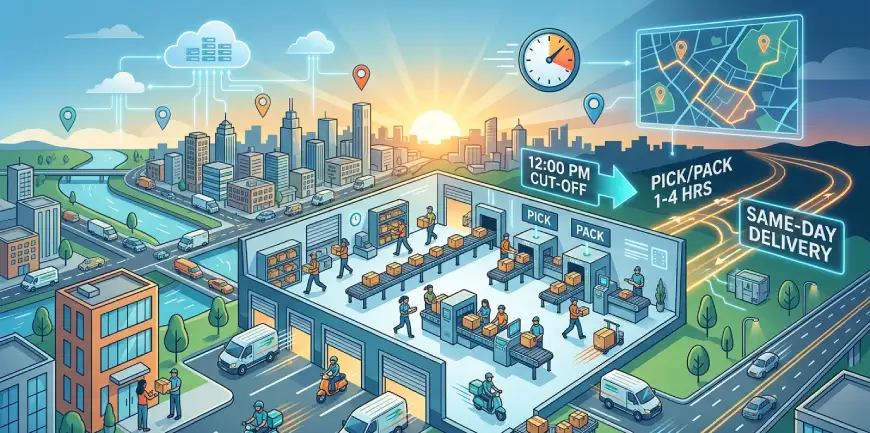
The time between when an order is placed and when it’s dispatched is the most critical metric for same-day delivery. To achieve evening delivery, orders must be picked, packed, and handed off to couriers by early to mid-afternoon. This leaves only four to six hours for the entire process.
Each step, from receiving the order to handing it off to the carrier, is tightly scheduled. Unlike standard fulfillment, there’s no room for delays; any hold-up can lead directly to missed deadlines. As a result, same-day fulfillment demands dedicated teams, prepped materials, and real-time workflow visibility, rather than just speeding up the usual process.
Why Cut-Off Discipline Matters
The cut-off time — the last moment an order qualifies for same-day dispatch — is the single most operationally critical parameter in this model. It sets the boundary between what the warehouse can physically process and what gets pushed to the following day.
Cut-off discipline breaks down in predictable ways. Marketing teams extend the cut-off window to capture more conversions without consulting operations. Customer service overrides the cut-off for individual complaints. Peak-period order surges push the team past the window, and the carrier departs with half the consignments sorted.
The operational solution is to treat the cut-off as a hard system constraint, not a guideline — enforced at the order management level, not by individual judgment calls. Orders that miss the window receive a clear, honest next-window notification rather than a promise that cannot be kept. Same-day operations that protect their cut-off times protect their SLA performance across every downstream metric.
Why Warehouse Location Is Critical
Standard fulfillment economics allow some flexibility on warehouse location — a facility an hour outside a major city still reaches most customers within two days. Same-day delivery eliminates that flexibility entirely. If the dispatch point is more than roughly 30 to 40 kilometers from the delivery address, same-day delivery becomes logistically and economically impractical in most scenarios.
Holding Inventory Closer to Customers
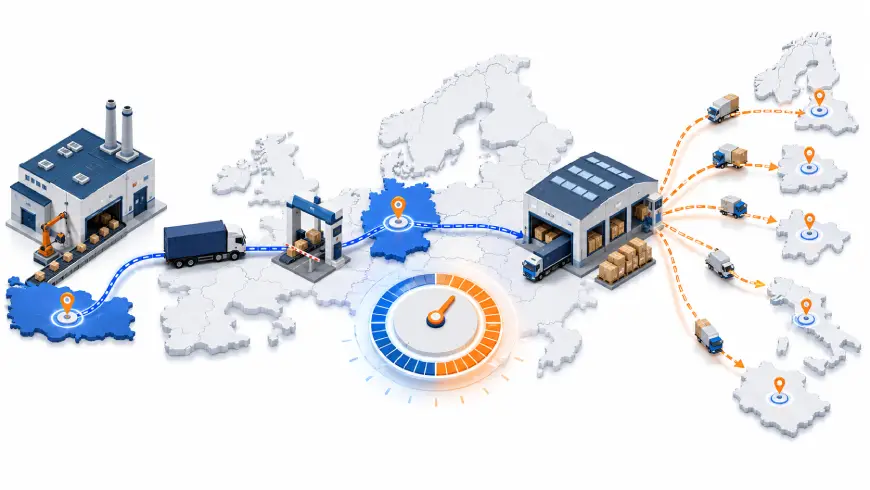
The architecture that enables same-day delivery at scale is distributed inventory: rather than holding all stock in a single central facility, a portion of fast-moving SKUs is positioned in smaller fulfillment nodes closer to where orders actually originate. These are sometimes called micro-fulfillment centers, urban nodes, or forward-positioned stock — the terminology varies, but the principle is the same.
This model does not require a complete infrastructure overhaul for most brands. The practical starting point is identifying the top 20 to 30 percent of SKUs that account for the majority of same-day requests, and ensuring those specific items are available at a location within courier range of the target delivery zone. The remaining long-tail SKUs can continue to ship from a central facility on standard delivery timelines.
The inventory split between central and local nodes needs to be actively managed. Demand signals in urban clusters differ from national averages, and a node that runs out of stock during a demand spike cannot be restocked in time for same-day orders. Local inventory planning, therefore, needs its own replenishment logic, separate from the main stock management cycle.
Regional Planning to Shorten Delivery Windows
Warehouse proximity to customers is necessary but not sufficient. The geographic coverage of each node — which postal codes or districts it can reliably reach within a same-day window — needs to be mapped explicitly before same-day is offered to customers in those areas.
Coverage mapping requires understanding not just straight-line distance but actual courier routing times, factoring in traffic patterns at different hours and handoff time at the dispatch point. A warehouse that can theoretically reach a district in 45 minutes may routinely take 90 minutes during afternoon delivery windows due to congestion.
This analysis determines which delivery zones can be included in a same-day offer, which require a tighter cut-off, and which are outside the same-day range entirely. Being explicit about zone coverage in the checkout experience — rather than offering same-day to all addresses and managing exceptions — is one of the most effective ways to protect delivery performance rates.
Picking and Packing for Same-Day Orders
The picking and packing process in a same-day operation is governed by a single constraint that general fulfillment does not share: time pressure is constant and non-negotiable. Process design decisions that are acceptable trade-offs in a next-day environment become direct causes of missed cut-offs in a same-day environment.
Single-Order vs Batch Picking
In standard fulfillment operations, batch picking — where a picker collects items for multiple orders simultaneously — improves warehouse efficiency by reducing travel distance per unit picked. In same-day operations, the calculus changes.
Same-day orders arrive throughout the order acceptance window and need to be processed as they arrive rather than accumulated into batches. Waiting to build a full batch introduces artificial delay. Single-order picking — processing each same-day order individually from receipt — maintains the velocity needed to meet cut-offs, at the cost of some per-unit efficiency. Most operations that run both same-day and standard fulfillment handle them as separate picking lanes with different rules: single-order for the same-day queue, batch for everything else.
The warehouse management system needs to be configured to route same-day orders into the priority lane automatically, without manual intervention or re-sorting at the packing station.
Designing a Faster Packing Line
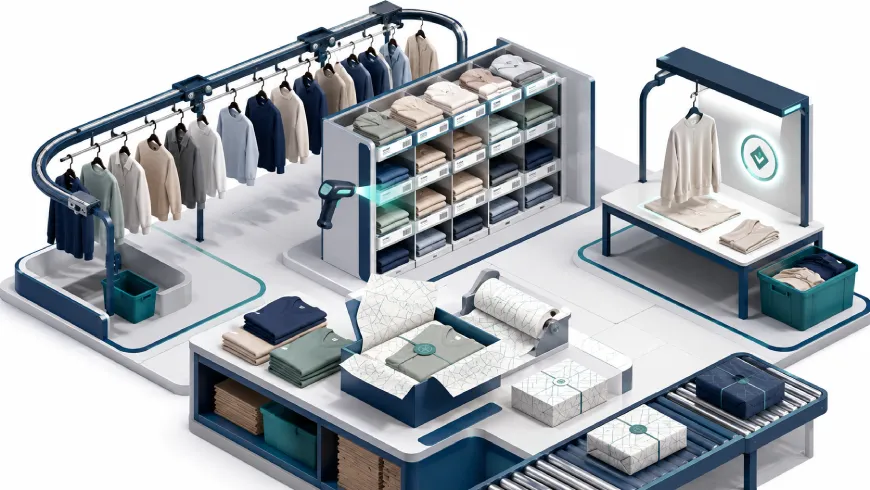
Packing station design for same-day orders prioritizes throughput over versatility. This typically means pre-staged packaging materials in the most common size ranges for same-day SKUs, label printing integrated directly into the station rather than at a separate step, and a physical layout that eliminates the need for packers to leave the station to retrieve materials or resolve exceptions.
Exception handling — damaged items, missing SKUs, incorrect picks — is the single greatest source of time loss in high-pressure packing environments. A same-day packing line needs a clear, fast escalation path for exceptions so that they are resolved or rerouted without holding up the station. In practice, this usually means a dedicated exception handler during peak same-day windows rather than routing exceptions back through the standard process.
Courier and Last-Mile Coordination
The fulfillment operation ends at the point of carrier handoff, but the same-day promise extends all the way to the customer’s door. Courier coordination is therefore not a post-fulfillment administrative task — it is an integral part of the same-day operation that requires the same level of process design as the warehouse itself.
Managing Delivery Time Slots
Same-day delivery works best when it is structured around defined time slots — morning dispatch for afternoon delivery, or midday dispatch for evening delivery — rather than a single undifferentiated “today” promise. Time slots give customers a specific expectation, give couriers a structured routing window, and give the fulfillment operation a clear dispatch target.
Time slot management also allows the operation to match courier capacity to order volume. If the afternoon slot is oversubscribed — more orders than the available courier fleet can handle — the operation can stop accepting new same-day orders into that slot and redirect them to the next available window. This is far preferable to accepting all orders and delivering half of them the following day.
The checkout experience needs to surface available slots dynamically based on order cut-off times and current capacity, not display a static same-day option that may not be deliverable for a given order placed at a given time.
Reducing Failed Deliveries
Failed delivery attempts are particularly costly in a same-day context. The window for re-delivery within the same day is often gone by the time a failed attempt is registered. A same-day failure typically becomes a next-day delivery, negating the value of the service entirely.
The primary driver of failed deliveries is address and contact data quality. Same-day operations benefit from address validation at the point of order submission — catching format errors, undeliverable addresses, or missing flat/unit numbers before the order enters the fulfillment queue rather than at the courier’s final destination.
The second driver is customer availability. Communicating a specific delivery window via SMS or notification as early as possible — ideally at the time of order confirmation — gives customers the information they need to be available or redirect the delivery, reducing failed attempt rates significantly.
Technology and Real-Time Visibility
Same-day operations run on tighter tolerances than standard fulfillment, which means problems that would be resolved before impacting delivery in a next-day model can breach SLAs before anyone has time to respond. Real-time visibility is what closes that gap.
Instant Order Status Updates
For same-day operations specifically, the critical visibility requirement is status at the transition points: order received → picking started → packed → dispatched → out for delivery → delivered. Any transition that fails to register within the expected time — order received but not picked within 20 minutes of the cut-off window, for instance — should generate an active alert rather than waiting for an end-of-day exception report.
Customer-facing tracking updates serve a separate but related purpose: they reduce inbound contact volume from customers checking on their orders. A same-day customer who receives proactive status updates is significantly less likely to contact support, which matters because support contacts during the fulfillment window create operational distraction at the moment of maximum time pressure.
For a detailed look at how to evaluate fulfillment software for order visibility and integration needs, see our [guide to order fulfillment software →].
Measuring Courier Performance
Courier performance in same-day operations needs to be measured against tighter metrics than standard delivery benchmarks. The relevant KPIs are: on-time delivery rate within the promised slot, first-attempt delivery success rate, and average time between scan events. These metrics need to be tracked at the route and driver level — not just aggregated — because same-day service failures are often concentrated in specific routes or during specific time windows rather than distributed evenly across the network.
Regular performance reviews with courier partners, based on this data, allow the operation to identify and address problems before they accumulate into systemic failures. Courier partners who consistently underperform on same-day SLAs need to be managed differently from those who underperform on standard delivery — because the same-day impact on customer experience is immediate and the recovery window is gone.
Which Brands Should Invest in Same-Day Fulfillment?
Same-day delivery infrastructure carries real cost — distributed inventory, dedicated staffing, courier premiums, and the operational overhead of running a higher-complexity process. Not every brand’s economics support it, and not every category benefits from it equally.
Brands with High Urban Demand
Same-day fulfillment has the strongest ROI for brands with concentrated demand in specific cities or metropolitan areas. When a meaningful share of orders originates within a single delivery zone, the unit economics of maintaining a local inventory node improve substantially — the cost of positioning stock closer to customers is spread across enough orders to justify it.
This profile fits many verticals: cosmetics and skincare brands with strong city-based customer bases, health and wellness products purchased on short decision cycles, fashion brands with same-day customers who want items for events or occasions, and consumer electronics with high urban order concentration. The common thread is that the customer’s purchase intent is time-sensitive enough that same-day delivery has genuine conversion and retention value — not just a nice-to-have.
Businesses Seeking a Customer Experience Edge
For brands competing in categories where products and pricing are roughly comparable across multiple providers, delivery speed and reliability can be a genuine differentiator. Same-day delivery creates a customer experience that is difficult for competitors without the infrastructure to replicate quickly.
The sustained advantage comes not from offering same-day delivery once but from consistently delivering on it. A brand that promises same-day delivery and delivers at 95 percent builds a meaningful trust asset over time. A brand that promises same-day delivery and delivers at 75 percent damages customer relationships faster than standard delivery would. The investment in same-day fulfillment is therefore simultaneously an investment in the operational discipline required to execute it reliably — and that operational discipline is itself the differentiator that is hardest to copy.
Same-day delivery at scale is an infrastructure problem before it is a marketing decision. The brands that build it well treat it as an operational system — with defined inputs, measurable outputs, and clear accountability at every step — rather than a service level that gets bolted onto existing processes. The investment is real, but so is the compounding return when the system works consistently.