

Packaging decisions often involve competing priorities. Marketing seeks premium, brand-building designs. Operations prioritizes efficient shipping and minimal claims. Finance focuses on protecting margins. Ultimately, customers expect their orders to arrive intact, on time, and without disappointment.
Many brands make initial packaging decisions quickly, often imitating competitors, and continue with these choices even when they are no longer effective. This can lead to overpacking, which increases shipping costs; underpacking, which causes damage claims; or packaging that fails to enhance the customer experience.
This guide explains how to match packaging formats to product categories through practical, logical decisions rather than general principles.
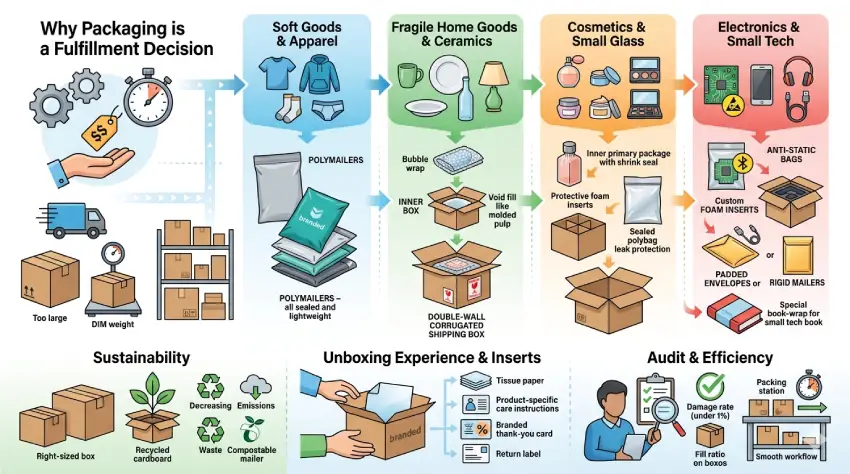
Table of Contents
Why Packaging Format Is a Fulfillment Decision, Not Just a Design Decision
A common mistake is viewing packaging solely as a brand and design issue, leaving fulfillment to implement decisions. In reality, packaging format significantly impacts fulfillment costs, which accumulate with every order.
Dimensional weight (DIM weight) pricing means that many carriers charge based on a package’s volume rather than its actual weight. A product that weighs 200 grams shipped in a box that’s 30% larger than necessary can cost more to ship than the same product shipped in a correctly sized box with a heavier actual weight. At 500 orders per month, this surplus shipping cost is a rounding error. At 10,000 orders per month, it’s a budget line that deserves attention.
Packaging for the mat also influences pick-and-pack. Complex, multi-component packaging increases assembly time compared to simple, standardized formats. While manageable at normal volumes, these complexities can lead to errors during peak seasons when temporary staff is involved.
The right packaging format is one that protects the product, represents the brand appropriately, ships efficiently, and can be executed consistently under real operational conditions—not just in an idealized packaging scenario.
Polymailers: When They Work and When They Don’t
What Are Polymailers?
Polymailers — flexible, sealed plastic pouches — are the highest-efficiency packaging for suitable product categories. They are lightweight, add minimal DIM weight, stack compactly, require little assembly, and are less expensive than similarly sized boxes.
Best Use Cases: Non-Fragile Goods
Polymailers are optimal for non-fragile products whose quality isn’t affected by flexible compression during transit. Soft apparel is the clearest example — t-shirts, hoodies, leggings, underwear, socks. Folded flat and sealed in a polymailer, these items arrive identically to how they’d arrive in a box, at a fraction of the cost and weight.
Other Suitable Product Categories
Other suitable categories include flat accessories such as scarves, belts, fabric hair accessories, non-fragile stationery, fabric toys, and soft goods in general. The key consideration is whether the item can be moderately compressed during transit without affecting its condition or customer perception.
When Polymailers Are Unsuitable
Polymailers are unsuitable for items with structural fragility, products where presentation is critical, or those requiring protection from compression. For example, glass bottles may break, books may arrive with bent corners, and cosmetic packaging may appear damaged even if it is not.
Branded Poly Mailers: The Middle Ground
Branded poly mailers are an effective middle ground between plain polybag pragmatism and premium box presentation. A well-designed matte polymailer with brand colors and a simple printed message can create a memorable unboxing experience at minimal cost. For fashion brands shipping soft goods at scale, this is often the most cost-effective packaging investment. Branded poly mailers provide structural protection, stack well on pallets and in warehouse shelving, accommodate void fill or inserts, and are familiar to customers as a standard shipping format.
The most frequent and costly mistake with corrugated boxes is improper size selection. Brands often use too few standard box sizes across all SKUs, resulting in boxes that are either too large, increasing DIM weight and void fill, or too small, risking product damage or requiring overpacking.
A well-managed operation typically uses three to five box sizes to cover the product range. Each new SKU should be evaluated for fit; if it does not fit within a 20-25% volume surplus, a new box size should be introduced. Although this may seem complex, shipping cost savings from right-sizing usually offset the added inventory costs within months.
Double-wall corrugated boxes offer superior protection for heavy, fragile, or high-value items and justify the additional cost for categories such as glass products, electronics, ceramics, and dense items. Single-wall boxes are sufficient for most non-fragile products within standard e-commerce weight ranges.
Box weight is important for international shipments or markets with weight-based pricing. A 300-gram box can significantly increase costs at high volumes, especially for lightweight products. Lightweight corrugated options are available, but their structural strength must be assessed based on product fragility.
Padded Envelopes and Rigid Mailers: The Often-Overlooked Middle Ground
Padded envelopes and rigid mailers represent an often-overlooked packaging category between polymailers and corrugated boxes.
Padded mailers, which are bubble-lined envelopes, are suitable for small items requiring light protection without the bulk of a box. Examples include phone cases, small electronics accessories, jewelry, cosmetics, cards, thin books, and samples. They offer low DIM weight, minimal assembly time, and sufficient protection for items not needing full box structure.
Rigid mailers, which are reinforced flat cardboard envelopes, are ideal for flat, bend-sensitive items that are not suitable for polymailers. Examples include art prints, certificates, vinyl records, illustrations, sticker sheets, and booklets. Using a rigid mailer with a “Do Not Bend” label is the appropriate solution, as polymailers or oversized boxes can compromise the product or increase costs.
Book mailers, which are corrugated wraps sized specifically for books, provide an efficient solution for books, journals, or similar items. If these products make up a significant portion of your range, dedicated book mailers offer better cost and protection than generic boxes.
Product-Specific Packaging Decisions by Category
Cosmetics and Glass
Glass packaging is standard for premium cosmetics but presents a fulfillment challenge due to its fragility and liquid contents. The solution is layered protection.
The inner layer consists of the product itself, secured with a pump lock or sealed cap and a shrink sleeve or security band. The middle layer uses product-specific cushioning, such as molded foam inserts or rigid dividers, to prevent movement. The outer layer is a shipping box sized to minimize void space, with double-wall construction for heavier glass items.
Polyurethane foam inserts offer the best protection-to-cost ratio for glass cosmetics at scale. Custom thermoformed inserts, while more expensive, reduce packing time and enhance the unboxing experience for higher price points. Molded pulp inserts are a sustainable alternative that now provide improved protection.
For liquid products not packaged in glass, add a secondary containment layer. A sealed polybag inside the box prevents leaks from damaging other order contents during transit.
Apparel and Fashion
Apparel packaging decisions focus on presentation quality, garment protection, and volume efficiency.
For premium and mid-market fashion brands, tissue paper wrapping prevents garments from shifting, enhances the unboxing experience, and protects delicate fabrics from snagging. The cost is minimal, while the perceived quality is significant.
For high-volume basics and mid-priced fashion, tissue paper increases labor time as volume grows. Packaging choices should align with price point and brand positioning. For example, a £15 basics brand shipping 5,000 units weekly and a £120 premium knitwear brand shipping 500 units require different packaging solutions.
Hanging garments such as blazers, formal dresses, and structured shirts are not well-suited to flat-folded packaging. Cylinder or roll packaging prevents creasing, while garment bags within boxes are suitable for high-value items. These options increase packaging costs and space requirements but help reduce returns and customer complaints.
Electronics and Tech Accessories
Electronics packaging must balance two potentially conflicting requirements: anti-static protection and physical shock absorption.
Anti-static bags are essential for circuit boards and components sensitive to electrostatic discharge, but not for assembled consumer electronics in standard retail packaging. Identifying which products require anti-static handling helps reduce costs and complexity.
Foam inserts sized to the product provide the best shock absorption for electronics, keeping items securely in place during transit. Loose void fill, such as packing peanuts or crumpled paper, allows products to shift and increases the risk of damage.
For small electronics accessories such as cables, adapters, cases, and chargers, padded mailers are often the most suitable format but are underutilized. Using corrugated boxes for these items unnecessarily increases material and shipping costs.
Fragile Home Goods and Ceramics
Ceramics, glassware, and fragile home decor are highly susceptible to transit damage, making premium protective packaging essential. The cost of a single broken item often exceeds the investment in upgraded packaging across many units.
The standard for fragile home goods is double-boxing: place the product in inner protective packaging, then in a corrugated box with an additional protective layer, and finally in a slightly larger outer shipping box. This structure ensures two layers of protection against external impacts. For high-value ceramics or glass, this practice is standard and justified by significantly reduced damage rates.
For medium-risk items that can tolerate some impact but are not fully rigid, use a foam or bubble wrap layer to prevent movement, a box sized within 10% of the padded product volume, and corner reinforcement for square-edged items.
Inserts and Brand Materials: ROI Framework
Each insert adds cost through materials, labor, and inventory management. Inserts are justified when their return, such as increased repeat purchases, social sharing, or customer lifetime value, exceeds their total cost.
The most effective inserts are specific rather than generic. For example, a personalized message referencing the product and offering a targeted discount is more impactful than a generic thank-you card. Specificity demonstrates attention to the customer experience.
Product-specific care instructions are valuable across nearly every category, as they reduce customer inquiries and returns caused by improper use. Their functional nature makes them justifiable at any price point.
Promotional inserts are most effective when the offer is specific and time-limited. For example, “20% off your next order, valid for 30 days” drives more immediate conversions than general loyalty program invitations. Track redemption rates to assess each insert campaign’s effectiveness.
Managing inserts requires operational discipline. Inserts must be in stock, version-controlled when offers change, and updated as product information evolves. Including an expired discount code is more detrimental than omitting the insert entirely.
Sustainable Packaging: Making Decisions That Actually Matter
Sustainability claims are common, but meaningful sustainable packaging decisions require more precision than simply switching to recycled cardboard.
The most impactful change for most e-commerce brands is right-sizing box ranges. Eliminating oversized boxes reduces unnecessary material use and shipping costs, making this the most direct form of sustainable packaging.
Beyond right-sizing, credible sustainable choices include eliminating single-use plastics when paper alternatives offer equivalent protection, selecting certified recycled corrugated materials, and removing unnecessary inserts and dunnage that add weight without value.
Biodegradable or compostable mailers are more expensive than standard polymailers and require specific disposal methods that most customers do not use. They are appropriate for brands with sustainability as a core value. For others, right-sizing and using recycled materials usually provide greater environmental impact at lower cost.
The Packaging Audit: How to Know If Your Current Choices Are Right
Most brands do not formally audit their packaging decisions, relying on past choices that appear adequate. This approach is reasonable until increased volume makes suboptimal decisions costly.
A packaging audit involves four key questions for each product or group: What is the damage claim rate, and does it exceed acceptable thresholds (over 1% for non-fragile, over 0.3% for fragile items)? What is the fill ratio—how much of the box is product versus void fill (below 60% suggests the box is too large)? How long does it take to pack, and does the packaging format affect this time? Is the unboxing experience appropriate for the price point and brand, or is it over- or under-engineered?
Systematically applying these four questions across your product range will identify packaging decisions that need review. Not all formats require change, but those causing damage claims, higher costs, or misalignment with brand positioning warrant adjustment.
Packaging is one of the few fulfillment areas where brand, operational, and financial objectives can be aligned. The right format protects the product, ships efficiently, represents the brand appropriately, and performs reliably in real warehouse conditions. Achieving this requires treating packaging decisions with the same rigor as product development and pricing, rather than treating them as one-time solutions.