
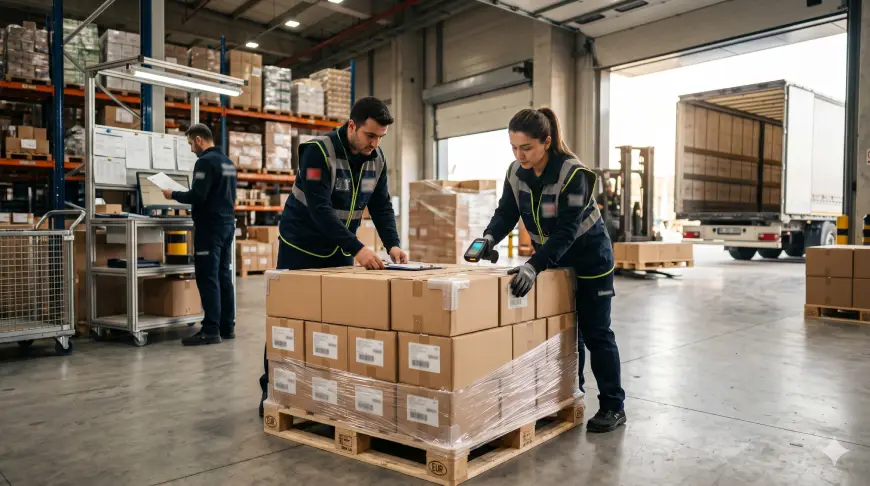

Turkish manufacturers hold a structural advantage in the European wholesale market, particularly regarding fulfillment. Geographic proximity, customs union access for industrial goods, and a competitive cost base—when total landed cost is considered—distinguish Turkish suppliers from Far East alternatives. Textile, home goods, leather, and furniture manufacturers across Turkey have leveraged these factors to establish strong relationships with European distributors.
Despite robust initial relationships, fulfillment infrastructure frequently emerges as the primary point of failure. Turkish manufacturers who deliver high-quality products at competitive prices may lose business due to operational issues such as incorrectly constructed pallets, delayed Electronic Data Interchange (EDI) confirmations, or unresolved partial shipment discrepancies that escalate into prolonged disputes. European wholesale buyers—including retailers, distributors, and department store chains—prioritize process reliability and standardized operational expectations over product quality alone.
This guide details the specific requirements for B2B fulfillment when Turkish manufacturers serve European wholesale buyers. It further identifies areas where conventional B2B fulfillment guidance does not address the unique challenges of this trade lane.
Distinct Operational Practices of European Wholesale Buyers
European retailers and distributors placing wholesale orders do not operate as scaled-up individual consumers. Although order structures may resemble those fulfilled domestically by Turkish manufacturers, the operational expectations differ significantly from the outset.
The Appointment-Based Receiving Model
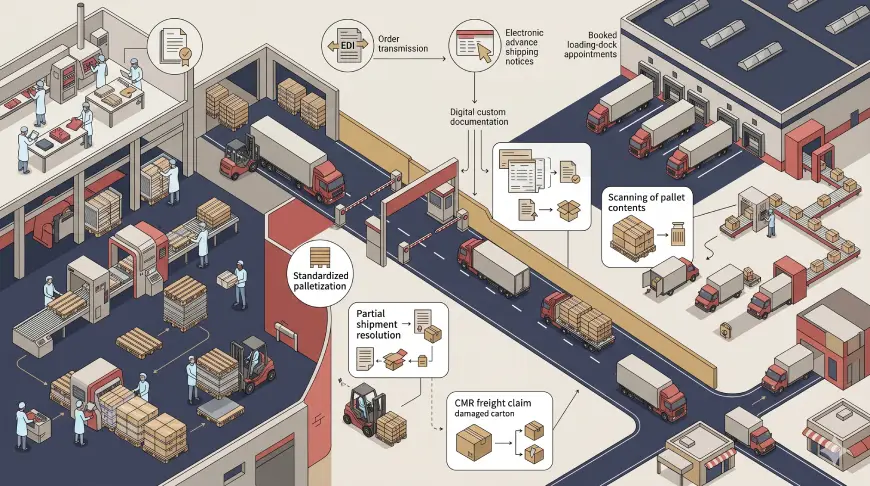
Most mid-size and large European retailers and distributors utilise appointment-based receiving systems (referred to as Zeitfenster-Buchung in German distribution centres and similarly formalised across France, the Benelux, and Scandinavia). Deliveries must arrive within a pre-booked window, typically 30 to 60 minutes, at a designated loading dock. Failure to meet this window often results in the truck being turned away and the delivery rescheduled for the next available slot, which may be several days later.
For Turkish manufacturers shipping via freight forwarders, appointment bookings must be scheduled with sufficient lead time to accommodate the actual transit time from Turkey. Transit times vary considerably depending on the mode: road shipments typically require 4 to 7 days to reach Central Europe, while sea-and-road combinations may take 10 to 14 days and offer lower costs but less predictable timing. Missing an appointment due to unforeseen customs delays or transit variances creates operational challenges stemming from logistics planning, rather than product quality.
EDI Is Often Not Optional
Electronic Data Interchange (EDI), which standardises the electronic exchange of purchase orders, shipping notices, and invoices between trading partners, is a fundamental requirement for many large European retailers. For Turkish manufacturers supplying German department store chains or French distribution groups, EDI compliance—particularly the transmission of an Advance Shipping Notice (ASN) prior to goods arrival—is often contractually mandated, with financial penalties (chargebacks) imposed for non-compliance.
Many Turkish exporters are unprepared for this requirement, as domestic B2B relationships in Turkey seldom necessitate such advanced system integration. In practice, manufacturers must either ensure their own ERP systems possess EDI capabilities or, more commonly for small- to mid-sized firms, engage a fulfillment or logistics partner equipped with EDI infrastructure to manage this integration on their behalf.
Pallet Standards Are Genuinely Different
The European wholesale market predominantly utilises the EUR-pallet standard (1200mm × 800mm), which differs from pallet dimensions commonly used in other regions. Turkish manufacturers who construct pallets to alternative specifications—either for cost considerations or because EUR-pallets are not the local default—encounter immediate challenges upon delivery to European distribution centres, where dock equipment, racking systems, and automated handling are designed for the EUR-pallet format.
This issue can be addressed proactively, but it must be resolved prior to the initial shipment rather than upon notification from a European warehouse manager that the delivery cannot be processed. Pallet specifications should be explicitly confirmed with each European buyer or distributor during production planning, rather than assumed based on general industry practices.
Customs and Documentation: The EU-Turkey Customs Union Advantage and Its Limits
What the Customs Union Actually Covers
Turkey’s customs union with the EU, in place since 1996, eliminates customs duties on industrial goods moving between Turkey and EU member states — a genuine and underutilised competitive advantage for Turkish manufacturers compared to non-EU, non-customs-union competitors shipping the same product categories.
The advantage has real limits that matter for B2B fulfillment planning. The customs union covers industrial goods but excludes most agricultural products and has specific carve-outs and procedural requirements that vary by product category. Verification needs to happen at the HS code level for the specific product — assuming customs union coverage without confirming it for your exact product classification is a common and costly mistake.
Even within customs union coverage, every shipment still requires correct commercial documentation: a commercial invoice with accurate product description and HS code, a packing list that matches the physical pallet/carton breakdown precisely, and — depending on the product category — a certificate of origin (ATR.1 movement certificate) that formally establishes the goods’ eligibility for customs union treatment. Missing or incorrect ATR.1 documentation is one of the most common causes of unexpected duty charges and customs delays on this trade lane, even when the product itself would otherwise qualify for duty-free treatment.
Documentation Precision Matters More in B2B Than B2C
In B2C cross-border shipping, a documentation error typically delays a single parcel. In B2B wholesale freight, a documentation error can hold an entire pallet shipment — sometimes a full truckload — at customs, affecting every line item and every downstream commitment the buyer has made based on the expected delivery date. The operational stakes of documentation accuracy are categorically higher in B2B freight than in B2C parcel shipping, and the precision standard needs to reflect that.
Warehouse and Production Planning for European Wholesale Orders
Forecasting Against Purchase Order Cadence, Not Continuous Demand
B2B wholesale demand from European buyers typically arrives as discrete, larger purchase orders rather than the continuous order flow typical of D2C e-commerce. A European distributor might place a purchase order quarterly or even seasonally, for a quantity that needs to be produced or pulled from stock and shipped as a complete, accurate unit.
This changes the production and inventory planning logic for Turkish manufacturers. Rather than maintaining continuous safety stock calibrated to daily order velocity, B2B-focused operations need to plan around purchase order lead time: how much advance notice does the buyer typically give before the order needs to ship, and does current production capacity and raw material lead time allow the order to be fulfilled within that window? A manufacturer that discovers a capacity shortfall after confirming a purchase order with a European retailer has already damaged the relationship, regardless of how the shortfall is eventually resolved.
Quality Control Before Palletisation, Not After
For European wholesale buyers — particularly retail chains with their own incoming quality inspection processes — a quality issue discovered at the buyer’s receiving dock is far more costly than the same issue caught before the shipment leaves Turkey. Some European retailers apply formal chargebacks or compliance penalties for quality issues detected on receipt, separate from any product-level defect cost.
The practical implication: quality control checkpoints should be built into the process before palletisation, not treated as a final spot-check. For manufacturers working with a logistics or fulfillment partner, this often means the partner’s warehouse team performs a structured incoming inspection against an agreed checklist (correct SKU, correct quantity per carton, correct labelling, no visible damage) before building the pallet — catching discrepancies while they’re still cheap and fast to fix.
SLA Structure for European Wholesale Relationships
What “On Time” Actually Means in B2B Wholesale
In B2C, “on time” typically means delivered within a promised window measured in days. In B2B wholesale with European buyers, “on time” is frequently defined down to the appointment slot — a delivery that arrives the correct day but misses its booked time window may be treated identically to a delivery that’s a day late, because the buyer’s receiving dock schedule doesn’t have the flexibility to absorb timing variance.
The SLA between a Turkish manufacturer and their logistics or fulfillment partner needs to reflect this precision: not just “shipped within X days of order confirmation” but a structured commitment to appointment booking accuracy and the buffer built in to account for freight transit variability between Turkey and the destination market.
Partial Shipment and Discrepancy Protocols
When a European buyer receives a shipment that doesn’t exactly match the purchase order — short on quantity, an incorrect SKU mix, a damaged carton — the resolution process needs to be defined before it happens, not negotiated in the moment. European retail and distribution partners typically have standardised discrepancy reporting processes (sometimes integrated with their EDI systems) that expect a specific response timeline and format from the supplier.
A clear protocol covers: how the buyer reports a discrepancy (which document, which channel, which timeframe after receipt), how the Turkish manufacturer or their logistics partner investigates and confirms the discrepancy (matching against the original packing list and any photographic evidence from the warehouse before dispatch), and how resolution is executed — replacement shipment, credit note, or partial invoice adjustment. Manufacturers who handle this reactively, case by case, accumulate friction with buyers who expect process consistency.
System Integration: Bridging Turkish ERP and European Buyer Systems
The Translation Layer Problem
Most Turkish manufacturers run domestically-oriented ERP systems (Logo, Netsis, SAP Business One configured for Turkish tax and invoicing requirements) that were not built with European retailer EDI integration as a primary use case. The practical challenge is less about the ERP’s general capability and more about the specific translation layer needed to communicate in the formats European buyers expect — EDIFACT or ANSI X12 message formats for purchase orders, ASNs, and invoices, GLN (Global Location Number) identification for shipping locations, and GTIN/barcode standards for product identification that the buyer’s receiving systems expect to scan against.
For manufacturers without the internal IT resources to build this translation layer themselves, a logistics or fulfillment partner with existing EDI infrastructure and experience serving European retail accounts removes a substantial technical barrier — effectively acting as the translation point between the manufacturer’s Turkish-oriented systems and the buyer’s European-standard systems.
Automating Order Confirmation and Shipping Notice
Beyond the technical integration, the operational discipline of timely order confirmation and the transmission of advance shipping notices needs to be built into the standard workflow, not handled as a manual, ad hoc task. A purchase order that’s acknowledged within hours (rather than days) and an ASN that’s transmitted as soon as the shipment is finalised (rather than after it’s already in transit) both materially improve the buyer’s planning confidence, which compounds into stronger commercial relationships over multiple purchase order cycles.
Returns, Claims, and Damage Resolution Across the Turkey-Europe Lane
Freight Claims Are Different From Parcel Claims
When freight damage occurs on a pallet shipment moving from Turkey to a European destination, the claims process involves the freight carrier or forwarder’s liability framework — typically governed by CMR (Convention on the Contract for the International Carriage of Goods by Road) for road freight, which has its own documentation and timeline requirements distinct from standard parcel carrier claims.
A CMR claim requires that damage be noted on the delivery documentation at the time of receipt (a buyer who signs for goods without noting visible damage significantly weakens any later claim), and the claim itself needs to be filed within a defined timeframe with supporting documentation: photographs, the original packing list, and the signed delivery note showing the discrepancy.
Turkish manufacturers shipping via a logistics partner with freight forwarding experience on this specific lane benefit from a partner who understands CMR claims processes natively, rather than having to learn this framework reactively after the first damage dispute.
Partial Acceptance Scenarios
European wholesale buyers frequently exercise the option to partially accept a shipment — accepting the units that arrived correctly and rejecting the portion that’s damaged or doesn’t match the purchase order, rather than rejecting the entire shipment. This requires the Turkish manufacturer’s invoicing and inventory systems to handle partial fulfillment cleanly: invoicing only for the accepted quantity, processing the rejected portion as a return or replacement, and updating inventory records to reflect what’s actually with the buyer versus what’s back in Turkish or European warehouse stock.
Manufacturers without a clear partial acceptance workflow often resolve this manually and slowly, which extends the dispute resolution timeline and creates exactly the kind of friction that erodes a wholesale buyer’s confidence in continuing the relationship.
Choosing a Fulfillment or Logistics Partner for Turkey-to-Europe B2B Trade
What Generic 3PL Experience Doesn’t Cover
A logistics partner with strong B2C parcel fulfillment experience — fast pick-and-pack, efficient last-mile delivery — does not automatically translate into competence on the specific requirements of Turkey-to-Europe B2B wholesale freight. The relevant experience profile is different: EUR-pallet building and freight consolidation, EDI integration with major European retail and distribution systems, ATR.1 and customs union documentation handling, and CMR claims experience.
Before committing to a partner for this specific trade lane, confirm directly: how many EUR-pallet shipments do they process monthly, and to which European markets specifically? What EDI standards and retailer connections do they currently support, and can they provide a reference customer using a comparable EDI setup? How is ATR.1 and customs documentation handled — in-house or through a customs broker relationship, and what’s the typical processing timeline? What is their CMR claims track record — average resolution time and dispute outcomes from the last 12 months?
Why Physical Presence on Both Sides of the Lane Matters
A partner with physical fulfillment infrastructure in both Turkey and a European location (most commonly Germany, given its central geography and strong freight network) offers a structural advantage specific to this trade lane: production-side quality control and palletization happens correctly in Turkey before the goods ever cross the border, while the European-side warehouse can hold safety stock positioned for faster replenishment to wholesale buyers, handle returns and claims locally without round-tripping goods back to Turkey, and provide EDI and language support in the buyer’s own market and time zone.
This dual-location model converts what would otherwise be a single long-distance trade relationship — with all the latency and friction that implies — into something closer to a distributed operation that happens to source production from Turkey.
Building the Relationship, Not Just the Shipment
European wholesale buyers — particularly retail chains and established distributors — are evaluating Turkish manufacturers on a longer time horizon than a single purchase order. The operational consistency of the first several shipments determines whether the relationship scales into a recurring, larger commercial arrangement or stalls after an initial trial order due to friction unrelated to the product itself.
The manufacturers who build durable European wholesale relationships from Turkey are the ones who treat fulfillment infrastructure — pallet standards, EDI compliance, documentation precision, claims handling — with the same seriousness as production quality. The product gets the manufacturer the first order. The fulfillment process determines whether there’s a second one.