

Beauty products are deceptively hard to fulfill. On paper, a skincare serum looks like “just another SKU.” In reality, it’s often glass, sometimes pressurized, sometimes liquid, and almost always tied to customer expectations that are higher than average. One cracked bottle, one leaking cap, or one melted formula can turn a perfect order into a refund, a negative review, and a customer you may never win back.
That’s why beauty fulfillment and fragile product fulfillment need more than standard pick-and-pack. They require product-aware packaging, careful handling, proper storage conditions, and a returns process that protects both hygiene and brand trust. Below is a practical, human-first guide to doing cosmetic logistics the right way—so you reduce damages, lower claims, and keep customers excited to reorder.
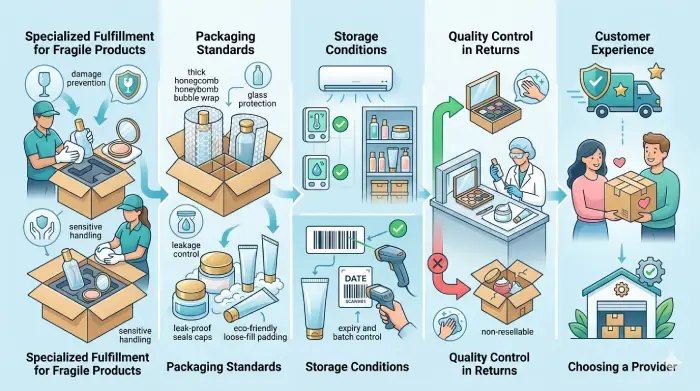
Table of Contents
Why Fragile Products Need Specialized Fulfillment
Fragile goods aren’t forgiving. When a product is breakable or leak-prone, small mistakes compound fast: one rushed packer, the wrong box size, a missing seal, or a poorly chosen filler can cause damage at scale. Unlike many categories, beauty products also carry a “premium expectation.” Customers assume the product will arrive spotless, safe, and beautifully presented—because that’s what the brand experience promises.
Specialized fulfillment is really about one thing: controlling risk. You’re not just moving inventory; you’re protecting the product’s integrity from warehouse shelf to customer doorstep.
Common Risks in Shipping Fragile Goods
The obvious risk is breakage, especially with glass bottles and jars. The less obvious risks are often more common: micro-cracks, loose caps, pumps that get pressed during transit, labels scuffed by friction, or secondary packaging collapsing inside the box. Liquids add another layer—leaks can destroy not just that item, but everything else in the shipment.
Damage risk also depends on the shipping journey. Parcels get tossed, stacked, dropped, and exposed to temperature changes. If your packaging only works when handled gently, it won’t survive real-world shipping.
Matching Packaging to Product Type
“Standard packaging” is a myth in beauty. A glass dropper bottle needs different protection than a plastic tube. A powder compact needs shock absorption. A pump bottle needs pressure protection to prevent accidental dispensing. Matching packaging to product type means creating simple packaging rules so the warehouse doesn’t have to guess.
The best approach is to define packaging by product profile: fragile vs non-fragile, liquid vs solid, high-value vs standard, temperature-sensitive vs stable. When packaging logic is documented and easy to follow, your operation becomes consistent—and consistency is what reduces damage.
Packaging Standards for Beauty Products
Packaging is where most beauty fulfillment wins or loses. Great packaging isn’t only about preventing damage; it’s about delivering confidence. When a customer opens the box and everything is clean, secure, and intentional, your brand feels trustworthy. When they open it and see a sticky leak or a cracked jar, the brand feels careless—even if the product itself is excellent.
A strong packaging standard also protects margin. Every damage claim triggers replacement shipping, support time, and often a discount to “make it right.” Preventing the issue at the packing table is cheaper than fixing it afterward.
Protecting Glass Bottles and Jars
Glass needs controlled movement. The goal is simple: the item shouldn’t be able to bang into anything, including the box walls. Use cushioning that absorbs shock and prevents shifting—especially around the neck of bottles, which is a common break point. Avoid “empty space” inside the carton; void space is where momentum builds during drops.
It also helps to separate glass items from each other. Two glass jars packed together without separators are basically guaranteed to collide at some point. Use dividers, wrap individually, or create a “glass zone” inside the box where each item has its own protection.
Extra Measures for Liquid Products
Liquids fail in predictable ways: caps loosen, pumps dispense, seals break, and temperature changes increase pressure. The best defense is layered containment. First, ensure the primary closure is secure (and consider tamper seals where possible). Second, add a secondary barrier like a poly bag or shrink wrap so a leak doesn’t ruin the entire order. Third, use absorbent material strategically for high-risk liquids.
If you ship oils, serums, or products with thin viscosity, treat them as higher risk. A tiny leak can spread and create the “everything arrived ruined” moment. Extra protection may feel like a small cost increase per order, but it’s often cheaper than a single replacement shipment.
Why Storage Conditions Matter
Beauty products aren’t only fragile—they’re chemically sensitive. Heat, humidity, and poor storage can degrade formulas, warp packaging, or shorten shelf life. Even if the product arrives unbroken, a customer will notice if texture, smell, or performance feels “off.” That’s why cosmetic storage requirements matter as much as packaging.
Storage also affects compliance and brand risk. If you can’t trace batches or manage expiry dates properly, you may face higher loss rates, incorrect shipments, and recall challenges.
Temperature and Humidity Control
Some beauty products are stable, but many aren’t. High heat can cause separation, melting, or pressure buildup. Humidity can damage labels, cartons, and powders. Climate-controlled storage doesn’t always mean cold storage—it often means keeping conditions stable and within safe ranges, especially during summer peaks.
You don’t need a lab-grade environment for every SKU, but you do need awareness. Identify which products are temperature-sensitive, which are humidity-sensitive, and which can tolerate normal conditions. Then store accordingly, so the product arrives as intended.
Expiry Date and Batch Tracking
Expiry dates are a big deal in beauty. Customers expect fresh products, and many retailers require strict compliance. Batch tracking (lot traceability) protects you operationally: you can isolate issues, manage FEFO (first-expire, first-out), and reduce write-offs.
Batch control also improves customer trust. If a customer ever asks “Is this fresh?” or reports a problem, you can trace the product. Without that capability, you’re guessing—and guessing is expensive.
Quality Control in Returns Processing
Returns in beauty are tricky because hygiene and product integrity are non-negotiable. You can’t treat a returned lipstick the same way you treat a returned t-shirt. The goal is to protect customers while protecting your inventory value—without reselling items that shouldn’t be resold.
A strong returns QC process reduces risk, prevents reputation damage, and helps you recover value through correct classification.
Resellable vs Non-Resellable Returns
Not every return can go back into sellable stock, even if the product looks fine. The classification should be rule-based: sealed and unopened might be eligible, opened or tampered items are typically not. Packaging condition matters too—if the box is crushed or the label is damaged, the product may need to go to secondary sales channels instead of full-price stock.
Clear inspection checklists help teams make consistent decisions. Without a checklist, return classification becomes subjective, and that leads to risk and inventory confusion.
Hygiene Standards in Returned Goods
Hygiene policy should be strict and clear. If an item has been opened, used, or appears contaminated, it should not return to regular inventory. This protects customers and shields your brand from the worst outcome: selling a questionable product that triggers complaints or safety issues.
Even when returns are not resellable, you can still learn from them. Track return reasons and link them to operational data. If customers frequently return broken items, it’s packaging. If they return because of leakage, it’s closure integrity or handling. Returns are a feedback channel.
Protecting Customer Experience in Fragile Product Fulfillment
Beauty is emotional. Customers often buy these products as self-care, a gift, or part of a routine. When an order arrives damaged, the disappointment is stronger than in many other categories. That’s why protecting customer experience is not just “nice”—it’s a retention strategy.
Customer experience is protected through two levers: preventing damage and resolving issues fast when damage happens.
Better Packing Accuracy
Packing accuracy is not only “right SKU.” It’s also the right packing method for that SKU. A glass bottle packed like a plastic tube will fail. The best operations use packaging playbooks: if the order contains fragile items, the system triggers specific packing rules—box type, cushioning amount, secondary containment, and labeling.
When teams follow consistent packing quality standards, claims fall, support workload drops, and customers trust the brand more.
Faster Damage Resolution
Even with perfect standards, some damage will happen. What matters is how you respond. A clear replacement workflow can turn a bad moment into a loyalty moment. Customers want quick acknowledgment, fast reshipment, and minimal effort.
The strongest brands make it easy: simple claim submission, fast decisioning, and replacement shipped quickly—often without forcing the customer into a long investigation. If you treat the customer like they’re “trying to get a free product,” you lose them. If you treat them like you’re accountable, you often keep them.
Choosing the Right Fulfillment Provider for Fragile Items
Not every 3PL is built for fragile items. Many providers can ship sturdy products efficiently but struggle with breakables, liquids, and high-expectation packaging. If you outsource, the provider becomes your hands—so their process becomes your brand.
Choosing the right partner is about capability, infrastructure, and discipline—not just price.
Advanced Packaging Capabilities
A fragile-ready partner should have experience with protective materials, custom packing rules, and staff trained for careful handling. Ask about their standard methods for glass and liquids, and how they ensure consistency during peaks.
It also matters whether they can support your packaging experience: branded boxes, inserts, tissue paper, special seals, and kitting. If your brand promise is premium, your partner must be able to execute premium packing reliably.
Controlled Storage Infrastructure
Beauty products often need stable storage conditions. A strong provider should offer controlled storage where needed, clean and organized facilities, and disciplined inventory management practices like FEFO and batch tracking. If they can’t track expiry dates or lots, you carry a major operational risk.
Also ask about security and handling standards. High-value cosmetics can be shrinkage targets. Controlled access, audit logs, and reliable inventory counting processes protect your margin.