

If you run an e-commerce business, the words warehouse and fulfillment center often get used interchangeably—but they’re not the same. Both are part of modern e-commerce logistics, yet they serve different purposes. A warehouse is designed primarily for storage and inventory holding, while a fulfillment center is designed for fast, repeatable order processing and customer delivery. Choosing the right setup impacts cost, delivery speed, customer satisfaction, and your ability to scale.
This complete comparison explains what each facility is, how they work in the supply chain, the key differences in function, cost, and technology, and how to decide which option fits your business.
Table of Contents
Understanding the Core Concepts
Before comparing costs or performance, it helps to clarify definitions. The difference is not only physical space—it’s operational intent. Warehouses are built to store inventory efficiently. Fulfillment centers are built to move inventory quickly and accurately.
What Is a Warehouse?
A warehouse is a facility used for bulk storage and inventory management. It’s optimized for receiving goods, storing them safely, organizing stock, and preparing inventory for distribution when needed. Warehouses are common in manufacturing, wholesale, and B2B distribution where inventory may sit for longer periods and shipments move out in larger quantities.
Warehouse operations focus on long-term storage efficiency: pallet racking, inventory counts, replenishment, and maintaining stock availability for future demand.
What Is a Fulfillment Center?
A fulfillment center is a logistics hub designed for active order processing—especially for e-commerce. Instead of simply storing inventory, it focuses on quickly picking items, packing orders, generating shipping labels, coordinating carrier pickup, and providing tracking updates.
Fulfillment centers typically run at a higher operational tempo. Inventory movement is constant, and processes are built for speed, accuracy, and customer-focused delivery timelines.
How They Work Together in the Supply Chain
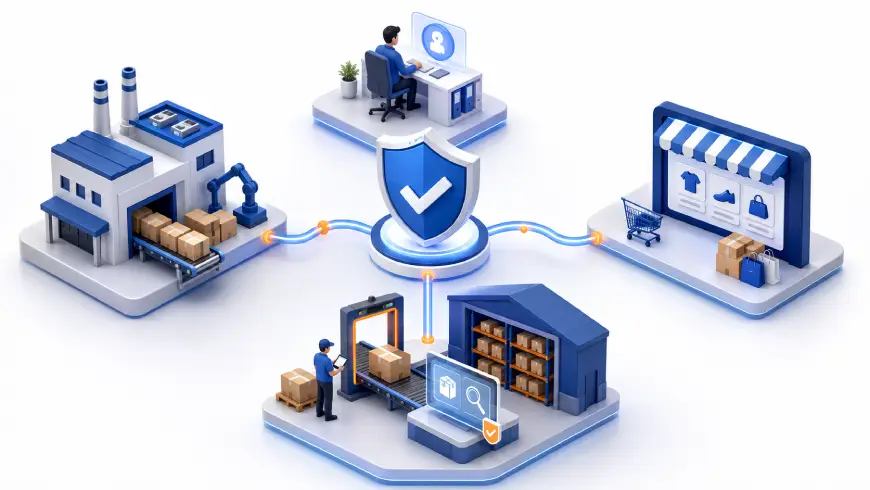
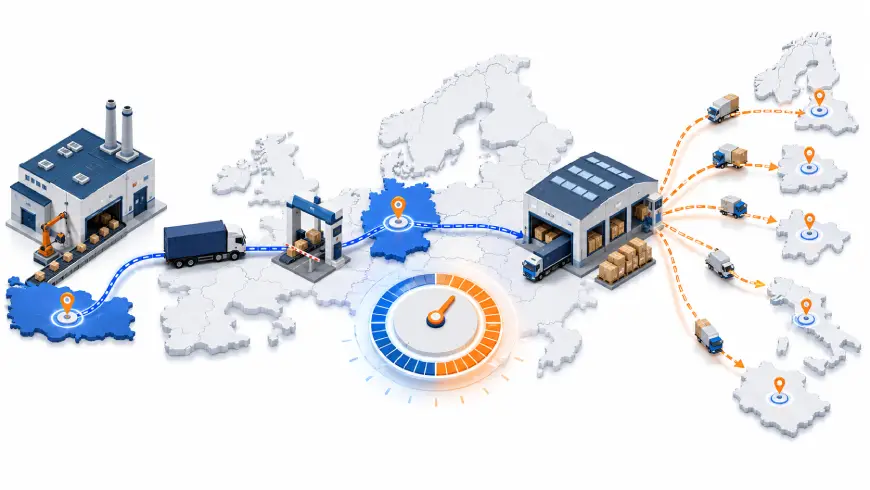
In many supply chains, warehouses and fulfillment centers complement each other. A business might store large volumes in a warehouse and then forward inventory to a fulfillment center based on demand. This supports better distribution logistics by balancing cost-effective bulk storage with fast order-to-door delivery.
In other cases, a single facility can play both roles—but the process design determines which function dominates.
Key Differences in Function and Purpose
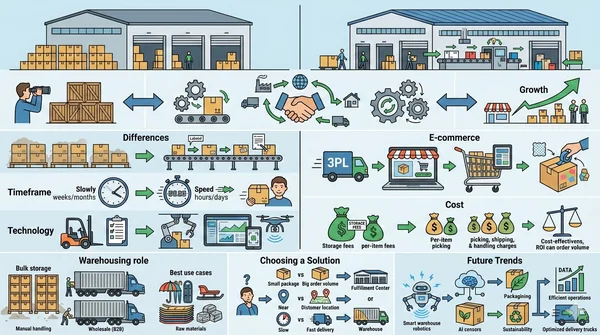
The biggest difference is not the building—it’s the workflow. Warehouses “hold.” Fulfillment centers “ship.” That shift affects staffing, systems, automation, and cost structure.
Storage vs Active Order Processing
Warehouses prioritize storage density and inventory stability. Products may move in and out in pallets or cases, and the operation often supports bulk shipments. Fulfillment centers prioritize frequent picks, small parcel packing, and high order volume.
If your business ships hundreds or thousands of small orders per day, you need an operation designed for an efficient order processing workflow—something fulfillment centers specialize in.
Timeframe and Customer Focus
Warehouses often support long-term storage and planned distribution cycles. Fulfillment centers are built around short-term distribution and customer delivery speed. That customer focus shows up in how fast orders are processed, how tracking is managed, and how quickly exceptions are handled.
If customers expect fast shipping and consistent delivery windows, fulfillment becomes a service promise—not just an operational task.
Technology and Automation Levels
Fulfillment centers usually run with more advanced fulfillment software and tighter automation: barcode scanning, real-time order status updates, integrated carrier systems, and dashboards that track throughput and exceptions.
Warehouses can also be automated, but many traditional warehousing setups are optimized for storage and bulk handling rather than real-time order tracking and rapid packing flows. The more e-commerce-driven the operation, the more technology and automation matter.
The Role of Fulfillment Centers in E-commerce
Fulfillment centers exist because e-commerce demands speed, visibility, and accuracy at scale. A warehouse can support e-commerce, but without dedicated fulfillment processes, it often struggles as order volume and customer expectations rise.
How Fulfillment Centers Manage Orders Efficiently
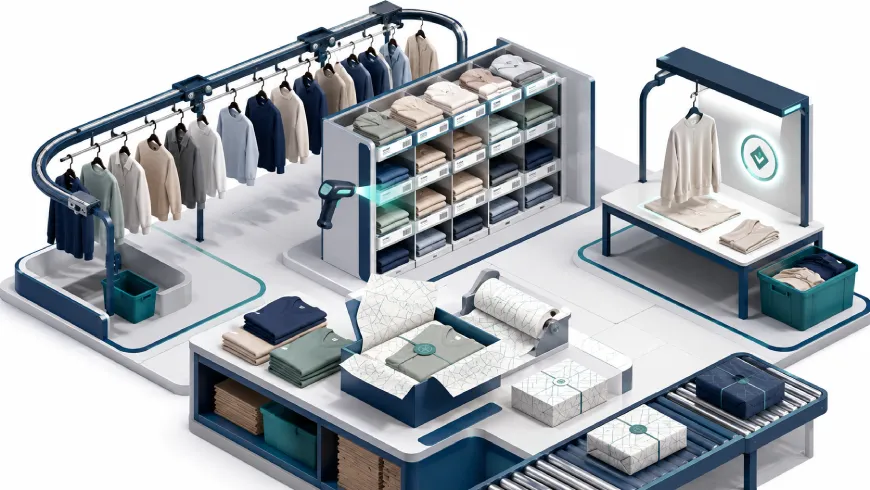
Fulfillment centers typically follow a standardized flow: orders enter the system, inventory is reserved, picking tasks are assigned, items are scanned for accuracy, orders are packed with defined standards, labels are printed automatically, parcels are sorted by carrier, and tracking information is pushed to the customer.
Real-time inventory updates help prevent overselling and reduce customer service issues. This operational design allows high-volume processing without relying on “heroic” manual effort.
Benefits of Using a Fulfillment Center
For many e-commerce brands, the biggest benefits are speed, consistency, and scalability. Fulfillment centers reduce operational chaos by using repeatable processes that lower error rates and improve throughput. They often support faster delivery by hitting carrier cutoffs reliably and optimizing routing.
They can also reduce overhead by shifting the burden of staffing, space, and system management to a specialized operation—especially when using a third-party logistics partner.
When to Switch from Warehouse to Fulfillment Center
A common sign is when order volume becomes too high for a storage-oriented operation to handle without delays and errors. If your team spends more time firefighting missed shipments, mispicks, and “where is my order?” requests than improving processes, you’ve likely outgrown a warehouse-first approach.
Another signal is delivery expectations. When customers expect rapid shipping and transparency, fulfillment becomes a competitive requirement. That’s often when brands move toward dedicated fulfillment centers or outsource to a 3PL.
The Role of Warehouses in Supply Chain Management
Warehouses remain essential because not every business needs high-speed e-commerce picking. For many industries, bulk storage and planned distribution are the priority, and warehouses handle that efficiently.
Benefits of Traditional Warehousing
Warehousing is often cost-effective for holding large-scale inventory. Warehouses support stable storage, pallet-based movement, and predictable replenishment. They’re well-suited for businesses with wholesale distribution, manufacturing supply, or large seasonal inventory needs.
If your shipments are typically bulk or B2B, traditional warehousing can be the right fit—especially when order frequency is lower and storage efficiency matters most.
Limitations of Warehousing for E-commerce
Traditional warehousing can struggle with e-commerce because small-order fulfillment requires different workflows: frequent picking, fast packing, accurate labeling, and real-time tracking. If the warehouse isn’t designed for this, the result is slower fulfillment, higher error rates, and limited visibility for customers.
Manual inventory handling can also cause inaccurate stock counts, leading to overselling or delayed shipments—both of which damage customer trust.
Best Use Cases for Warehouses
Warehouses are ideal for wholesale storage, manufacturing inventory buffers, and seasonal stock management where goods need to be held and distributed in larger units. They’re also useful when businesses need to store inventory across long cycles, such as imported goods waiting for distribution or materials staged for production.
Cost Comparison: Fulfillment Center vs Warehouse
Cost comparisons can be tricky because the two models price different outcomes. Warehouses price storage efficiency. Fulfillment centers price speed and order processing capability. The “cheaper” option depends on what you need.
Understanding Storage and Handling Fees
Warehouses typically emphasize storage costs: rent, pallet positions, equipment, and general handling. Fulfillment centers often charge per order, per pick, per package, plus storage. This creates a variable cost structure tied to throughput.
If you have slow-moving inventory, storage cost matters more. If you have high throughput, handling fees dominate your cost structure.
Technology and Labor Costs
Fulfillment centers usually require higher labor coordination and more technology investment: scanning systems, integrated order management, and carrier automation. That can raise operational cost—but it often reduces error rates and improves speed, which protects revenue and customer satisfaction.
Warehouses can be cheaper on technology, but if manual work increases errors and delays, the indirect cost can rise through returns, customer support, and lost repeat purchases.
Which Option Is More Cost-Effective?
Cost-effective doesn’t always mean lowest cost per unit. It means best logistics ROI: the option that supports your delivery promise, protects customer satisfaction, and scales without collapsing.
For low order volume with long-term storage needs, a warehouse model can be cost-effective. For high order volume with customer-facing delivery expectations, a fulfillment center is often the better investment.
Choosing the Right Solution for Your E-commerce Business
Your decision should be based on order patterns, customer expectations, and operational maturity—not just the cost quote.
Factors to Consider When Deciding
Start with your operational reality: average orders per day, peak season volume, average items per order, product size/fragility, customer locations, shipping frequency, and required delivery timelines.
Then consider your ability to manage complexity. If your business is growing fast, the right solution is often the one that keeps service stable during growth.
When to Outsource to a Fulfillment Partner
Outsourcing makes sense when you want faster scaling, better shipping performance, and access to systems and expertise without building your own infrastructure. A 3PL can provide warehousing and fulfillment services together, especially useful if you ship to multiple regions or need multi-channel coordination.
The key is to choose a partner with strong integration, clear SLAs, and transparent reporting—because outsourced logistics requires structured collaboration.
Creating a Hybrid Logistics Model
A hybrid model combines warehousing and fulfillment. For example, you can hold bulk inventory in a warehouse and replenish a fulfillment center based on demand. Or you can fulfill core products in-house while outsourcing specific regions or channels.
Hybrid models are especially valuable when you need both storage efficiency and fast delivery, or when you’re transitioning from one setup to another.
Future Trends in Warehousing and Fulfillment
The future of logistics is moving toward smarter automation, sustainability, and data-driven optimization. Both warehouses and fulfillment centers are evolving, but fulfillment tends to adopt customer-facing innovation faster due to e-commerce pressure.
Smart Warehouses and AI-Driven Fulfillment
AI logistics tools are improving forecasting, inventory positioning, routing decisions, and exception prevention. Robotics in fulfillment is expanding with automated picking assistance and goods-to-person systems. The result is higher throughput with fewer errors and more stable service levels.
Smart warehouse technology will continue to blur the line between warehouse and fulfillment center—because storage facilities are increasingly expected to fulfill orders, not just hold inventory.
Sustainability in Storage and Delivery
Sustainability is becoming a cost and compliance factor. Efficient packaging, right-sized cartons, reduced damage rates, and optimized delivery routes lower waste and emissions. Warehouses and fulfillment centers will increasingly be measured not just on speed and cost, but also on environmental impact.
Eco-friendly fulfillment practices are also becoming customer expectations, especially in markets with strong sustainability awareness.
Data and Predictive Analytics for Efficiency
Predictive analytics enables better capacity planning, workforce scheduling, and inventory allocation across locations. Real-time optimization helps operations respond to demand fluctuations before they become delays.
As data quality improves, logistics becomes less reactive and more planned—reducing variability and improving both cost efficiency and customer experience.