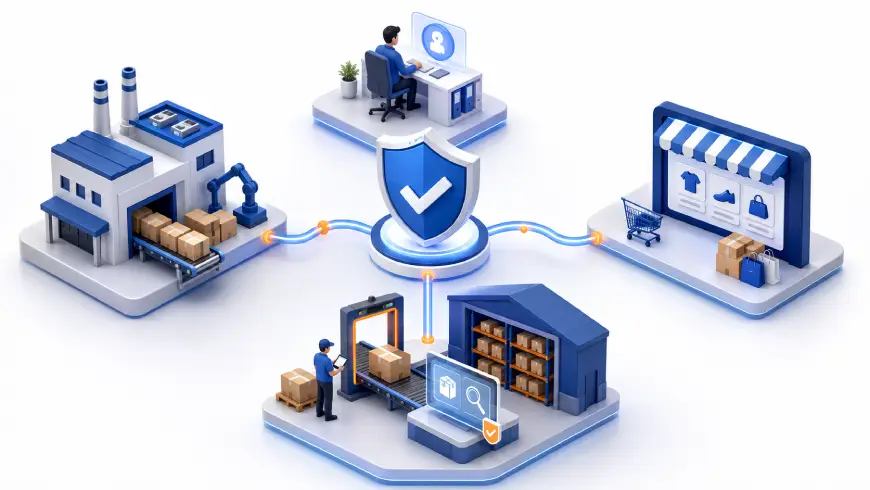


A Warehouse Management System (WMS) is the software layer that controls and optimizes what happens inside a warehouse—how inventory is received, stored, counted, picked, packed, and shipped. In modern e-commerce and logistics, a WMS is no longer a “nice-to-have.” It’s the operational engine that enables fast fulfillment, high order accuracy, and real-time visibility across channels.
If you’re scaling fulfillment, dealing with stockouts, struggling with inventory accuracy, or losing time to manual processes, a WMS is often the missing system that turns warehousing from reactive work into a measurable, repeatable process.
Table of Contents
Understanding the Role of WMS in Modern Fulfillment
Warehouses used to be storage-first environments. Today they’re execution centers, expected to process high volumes of orders quickly—often across multiple sales channels and delivery promises. A WMS sits at the heart of this shift by providing structured workflows, automating routine decisions, and keeping inventory data accurate in real time.
The Purpose of a Warehouse Management System
The main purpose of a WMS is to make warehouse operations predictable, efficient, and controllable. It does this by:
- Tracking inventory location and status inside the warehouse
- Assigning tasks to teams (receiving, replenishment, picking, packing)
- Validating actions through scanning and rules to reduce mistakes
- Optimizing movement to reduce wasted time and improve throughput
- Producing operational data so managers can improve performance
In short, it’s the system that turns “warehouse work” into a process you can measure, improve, and scale.
How WMS Differs from ERP and Inventory Software
A WMS is often confused with ERP or basic inventory tools, but they solve different problems:
- ERP focuses on company-wide business processes like purchasing, accounting, sales orders, and finance.
- Inventory management software often tracks stock quantities at a high level (what you have), but not always the detailed warehouse execution (where it is, what’s happening to it right now).
- WMS focuses on the warehouse execution layer: precise locations, task workflows, scanning verification, pick strategies, packing steps, and shipping coordination.
The WMS is the “warehouse control system” that ensures inventory data is not only recorded, but operationally true.

Key Features of Modern WMS
Modern WMS solutions go beyond stock tracking. They standardize workflows, reduce human error, and create real-time operational visibility. The best systems are built for speed, accuracy, and continuous improvement.
Real-Time Inventory Visibility and Tracking
Real-time visibility means the system knows where inventory is and what state it’s in—available, reserved, damaged, inbound, or returned. This is usually enabled by barcode scanning, and in more advanced operations, RFID.
With live inventory data, you reduce overselling, prevent picking the wrong item, and maintain confidence in what you promise customers.
Order Picking, Packing, and Workflow Automation
WMS platforms support different pick strategies depending on your volume and layout: single-order picking, batch picking, zone picking, wave picking, and goods-to-person flows. The system assigns tasks, guides workers to the right locations, and verifies picks through scanning.
On the packing side, WMS workflows can enforce packing standards, trigger correct label generation, and reduce mislabeling and missing items—especially important when orders are high-volume and fast-moving.
Cycle Counting and Inventory Accuracy
Instead of relying only on periodic physical inventory counts, a WMS enables ongoing cycle counting—small, targeted counts that maintain accuracy continuously. This reduces disruption and keeps inventory reliable throughout the year.
Cycle counting also helps detect root causes: receiving errors, unrecorded movements, mis-slotted SKUs, and shrinkage. Over time, it’s one of the fastest ways to improve stock accuracy.
Reporting, Analytics, and Performance Insights
A strong WMS provides operational analytics: pick rates, pack times, exception rates, inventory accuracy, order cycle time, and on-time shipment performance. These insights help managers identify bottlenecks and improve workflows.
Instead of running on guesswork, you get a clear view of where time and money are being lost—and where process changes will deliver ROI.
How WMS Improves Fulfillment Accuracy
Fulfillment accuracy is not a single action—it’s the result of consistent execution. A WMS improves accuracy by reducing variability, enforcing validation steps, and preventing common warehouse errors before they reach the customer.
Minimizing Human Errors in Order Processing
Human errors often come from manual picking, unclear locations, and rushed operations. A WMS reduces this through:
- Scan verification (right item, right location, right quantity)
- Guided picking workflows
- Exception rules (flagging mismatches early)
- Standardized packing and labeling steps
This reduces wrong items, missing items, incorrect labels, and shipping mistakes—some of the most expensive operational failures.
Speeding Up Order Turnaround Times
A WMS increases speed by reducing wasted motion and organizing work intelligently. Pick paths are optimized, tasks are prioritized, and work is balanced across teams. The result is shorter order cycle time and better ability to hit carrier cutoffs.
Faster turnaround isn’t only “moving quicker.” It’s avoiding delays caused by confusion, rework, and missing stock.
Synchronizing Data Across Fulfillment Channels
Modern fulfillment is multi-channel: Shopify, marketplaces, wholesale, and more. A WMS helps keep data synchronized so inventory updates reflect reality across channels. This reduces overselling and improves customer communication around order status.
When the WMS is integrated correctly, it becomes the execution truth that downstream systems can trust.
Benefits of Implementing a Warehouse Management System
The value of a WMS shows up in accuracy, productivity, scalability, and cost control. It reduces chaos by creating consistent operational rules.
Enhanced Inventory Control and Forecasting
With more accurate inventory data, forecasting improves. You can plan replenishment better, reduce stockouts, and lower overstock risk. Better inventory planning also supports faster growth because you can scale product lines and channels without losing control.
A WMS doesn’t replace demand forecasting tools—but it makes forecasting possible by ensuring your inventory data is reliable.
Reduced Labor and Operational Costs
A WMS reduces labor waste: less searching for items, fewer walking miles, fewer mistakes, and less rework. Over time, this lowers cost per order and improves throughput without needing the same linear increase in labor.
Cost savings also appear in fewer returns caused by warehouse mistakes, fewer reships, and lower customer support volume.
Scalable Solutions for Growing Businesses
As volume grows, manual operations break. A WMS creates structure that can scale: clear workflows, training-friendly systems, and measurable performance. This makes it easier to onboard new staff, add new storage zones, and expand to multi-warehouse setups.
For fast-growing businesses, scalability is often the primary reason to implement a WMS early.
Integration and Compatibility of WMS Solutions
A WMS is only as effective as its ability to connect with the rest of your stack. Integration determines whether your inventory stays accurate across platforms and whether your order-to-delivery process runs smoothly.
Connecting WMS with E-commerce Platforms
A good WMS should integrate with your selling channels so orders flow in automatically and inventory updates flow back out. This includes common platforms like Shopify, WooCommerce, and marketplace flows, as well as synchronization with Amazon models depending on how you manage inventory.
The goal is to avoid manual imports and prevent data drift that leads to stockouts and delays.
Cloud-Based vs On-Premise WMS
Cloud WMS solutions are popular because they’re faster to deploy, easier to update, and more flexible for distributed teams. SaaS models often reduce IT burden and allow quicker scaling across sites.
On-premise WMS solutions can offer deeper customization and internal control, but usually require more infrastructure management and longer implementation cycles. The right choice depends on security needs, complexity, and internal resources.
Ensuring Data Security and Compliance
Because a WMS contains sensitive order and customer-related operational data, security and compliance matter. Look for access controls, audit logs, encryption, and compliance alignment where relevant (such as GDPR expectations when handling EU customer data).
Security should be both technical and operational: who has access, how changes are approved, and how incidents are handled.
Choosing the Right Warehouse Management System
Choosing a WMS is not only a software decision—it’s a process decision. The best system is the one that matches your operational reality and supports your growth.
Assessing Business Size and Operational Needs
Start by mapping your warehouse complexity: SKU count, order volume, average items per order, returns volume, multi-channel needs, and whether you operate one warehouse or multiple locations. A lightweight system may work for simple operations, but high-volume or multi-warehouse needs require stronger workflow control.
Also consider future complexity: expansion to new regions, new product categories, or new fulfillment promises.
Evaluating Vendor Support and Features
Vendor support matters because fulfillment is a daily operation—issues can’t wait. Evaluate onboarding, training, response times, and whether the vendor has experience with businesses like yours.
Feature evaluation should focus on real use cases: receiving workflows, pick strategies, packing logic, integration reliability, reporting depth, and exception handling.
Calculating ROI Before Implementation
ROI comes from measurable improvements: fewer errors, faster processing, lower labor cost per order, reduced returns caused by fulfillment mistakes, and improved on-time performance.
Before implementation, estimate your current baseline and define targets. A WMS project succeeds when it delivers operational outcomes—not just when the software is installed.
The Future of Warehouse Management Systems
WMS technology is evolving toward AI-driven decision support, deeper automation integration, and sustainability-focused operations. The systems of the future won’t just track work—they’ll recommend and optimize it.
Artificial Intelligence and Machine Learning in WMS
AI will increasingly help with predictive analytics: forecasting workload, optimizing pick paths dynamically, predicting stockout risk, and identifying patterns that lead to errors or delays. Machine learning can also improve replenishment timing and exception handling by learning from historical operational data.
The near-term impact is “smarter operations” rather than fully autonomous warehousing.
Robotics and Smart Warehousing
Robotics adoption continues to grow, especially in goods-to-person systems, automated sorting, and picking assistance. WMS platforms will become more integrated with robotics control layers, orchestrating tasks across humans and machines.
Smart warehouses will use sensors, automated systems, and real-time optimization to increase throughput while reducing variability.
Sustainable and Green Warehousing Practices
Sustainability will push WMS features toward waste reduction: better cartonization logic, reduced damage rates, optimized replenishment moves, and energy-aware operational planning. Over time, warehouses will be measured not only by speed and cost, but by their environmental footprint.
Green warehousing practices will become a competitive advantage as regulations and customer expectations evolve.